It is 12 miles long. Part of it lies only a few hundred yards from our back doors. We cross it if we walk to Hoveringham and we motor along a half mile of its length if we journey to Southwell. We can step along a large stretch of it if we walk the bridleway from Castle Hill to the Sheepwash Bridge. It is the parish boundary of Thurgarton.
Many years ago, before accurate maps, villagers would have ‘beaten the bounds’ of their parish at Rogationtide, 5 weeks after Easter. Led by the vicar and church vestry the parishioners paraded around the fields and lanes noting the landmarks which had for centuries delineated the parish limits. In some parishes the markers were beaten with willow wands but in some districts a more robust approach was adopted when the village boys were beaten or bumped at each major boundary marker ‘ to fix these matters in their minds’.
A perambulation of Thurgarton parish
Thurgarton Parish by Des Holden
The boundaries to the parish of Thurgarton are a mixture of natural and man made features – streams, dykes, hedges, banks, tracks and carved stone markers. Our perambulation starts on the A612 at point 1 on the map and follows the boundary in a clockwise direction.
Points 1 to 4 – close up
Point 1 – Here in a small dip the main road leaves Thurgarton parish as it crosses the Halloughton Dumble. The bridge was known as Bougie Bridge – an intriguing name which conjours up bogeys and troublesome spirits. There is a long tradition of a boggart living on the nearby Thurgarton Dumble; this mischievous imp terrified villagers with its loud screams, so much so that one vicar of Thurgarton attempted to reassure his worried flock by the rather unlikely explanation that the noise was that of a bittern. Bogeys, boggarts and bitterns – who knows?
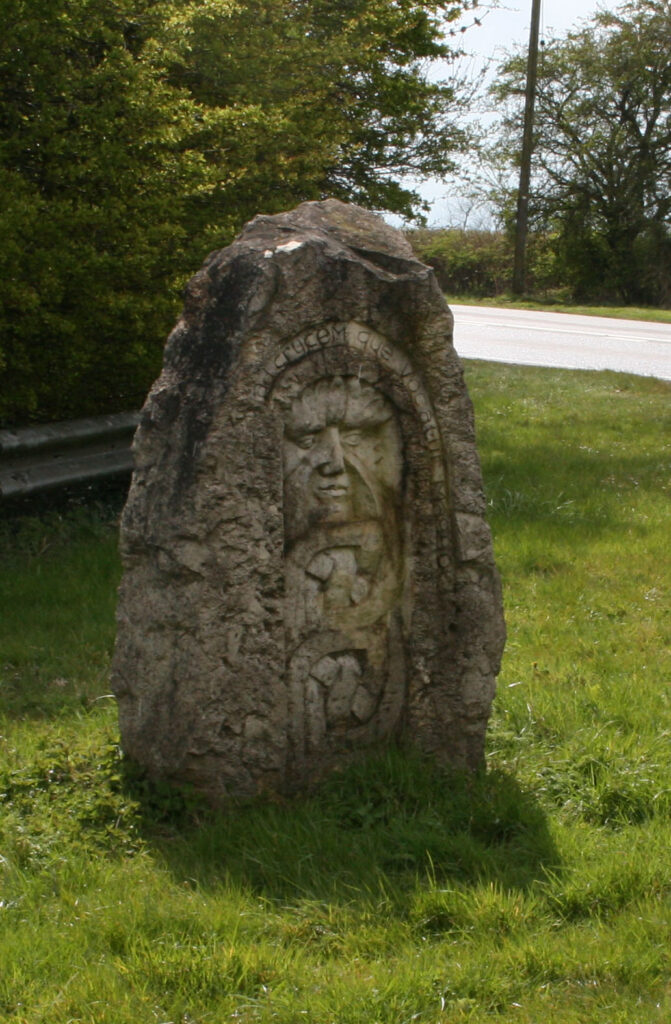
Point 2 – Following the A612 southwards one climbs a short hill on the crest of which is a sideroad to Bleasby marked by a large stone with the carving of a Green Man. This impressive monument was placed there by Bleasby Historical Society at the millennium; the location is close to a ‘High Cross’ which is recorded in 10th century documents. Such crosses were often used a boundary markers especially in prominent positions in the landscape, as here on the top of the hill looking down over the Trent valley, and where large landed estates met – the land to the south and west of this cross belonged to Southwell Minster whereas that to the north and west was held by Thurgarton Priory.
Stone marker at High Cross
Point 3 – A few paces further on we come to a track on the right called Magadales Drive . The name can be traced back to 1250 AD when it was known as Maggot’s Cross. It has been suggested that Maggot was a variation on Margaret but an alternative is the possibility that this lonely spot was a place of execution and burials of criminals.
Point 4 – We follow the A612 south down a shallow dip at the bottom of which the parish boundary leaves the road and deviates to the left along a small stream, (called Helbeck on old maps) alongside the hedgerow which descends in a shallow valley to meet the Bleasby Road at Scar Gap Bridge. This is the closest point on the parish boundary from the village.
Points 4 to 6 close up
Point 5 – The stream and hedgerow continues southeastwards to the railway line , this route was called Scargap Lane on old maps.
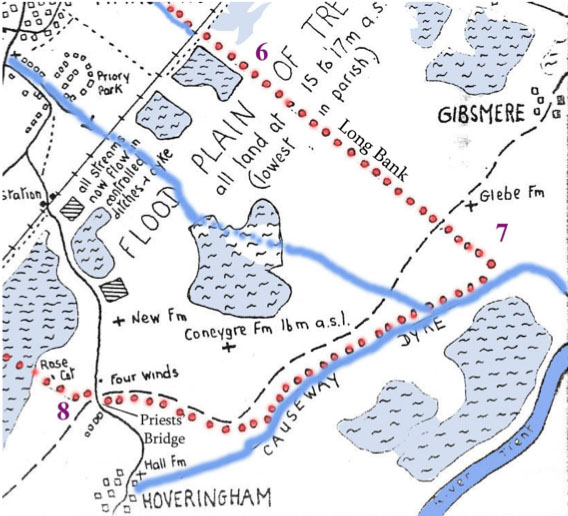
Point6 – South of the railway the boundary runs between two flooded gravel pits (that on the west now a fishing club lake) and continues in a straight line for a mile to meet the southern parish limit near to Glebe Farm (now called Horsepool Grange). The boundary between Thurgarton and Bleasby was marked by a raised wide bank alongside a deep dyke.
Long bank today
This major landscape feature was noted in 1897 by the Rev. Henry Williams, vicar of Bleasby, who described it as ‘ a curious raised bank, which must have been constructed at considerable labour, which may be seen from the railway , separating Bleasby from Thurgarton , no doubt made by the authority of the canons of Thurgarton Priory as their boundary’. The vicar was not wrong for the bank and ditch are mentioned in the mediaeval records of Thurgarton Priory as Long Bank and Long Ditch or Sewer and later in Manorial Court records when digging out of the main ditch was a recurring task for the parishioners. Gravel extraction has drastically altered the landscape but one section of the old bank still survives but sadly is not a public path.
Points 6 to 8 close up
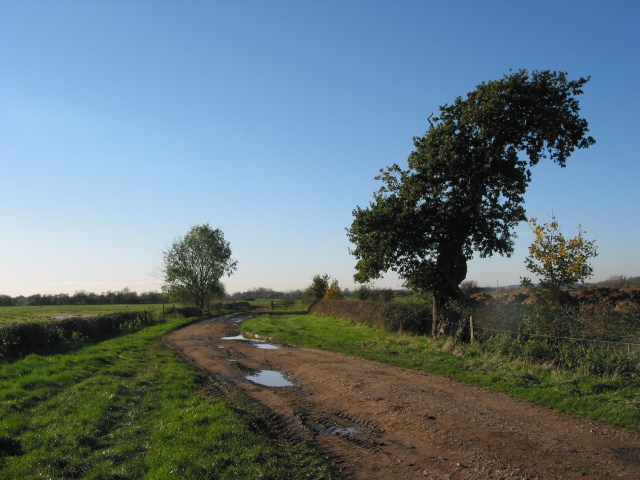
Point 7 – The boundary crosses the public footpath from Gibsmere to Hoveringham and joins the large Causeway Dyke (Nether Meadow Dyke on some old maps) which forms the southern limit of the parish. The footpath was once a major route from Nottingham to Newark heading through Gibsmere to the Trent crossing at Hazelford. Along this first stretch one can still see the wide lane between ditched hedges.
Remnant of old Nottingham to Newark road
The Causeway Dyke flows into the River Trent 50 yards south of this point but our way is to the west along the footpath which roughly follows the dyke and boundary through to the Hoveringham Road. Along this route we pass south of Coneygre Farm (the name is derived from rabbit warren) and through the site of the deserted mediaeval hamlet of Horsepool.
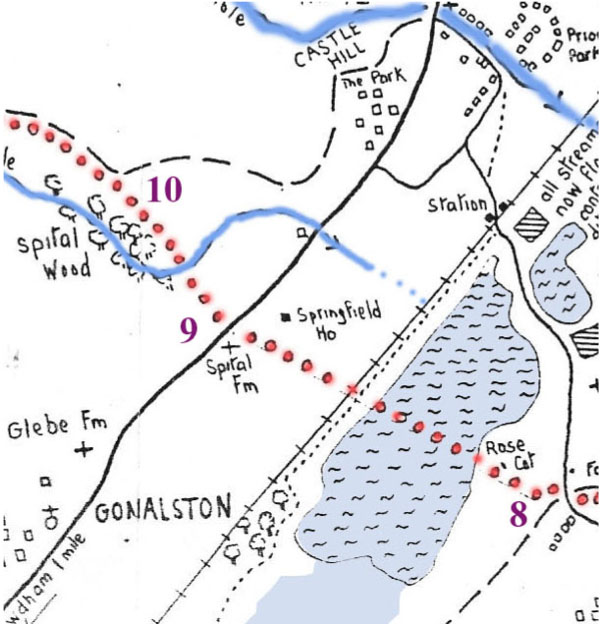
Point 8 – The boundary crosses the Hoveringham Road at Priest’s Bridge; the name is probably related to the canons of Thurgarton Priory who controlled the parish and the river crossings. The boundary encloses Four Winds and Rose Cottage within Thurgarton parish and then heads north to the big lake.
Point 8 to 10 close up
Point 9 – A straight line through the lake and over the railway line joins with an old hedge line that runs straight up to the east side of Spittal Farm on the A 612. The origin of the name Spittal Farm is a mediaeval hospital dedicated to St Mary Magdalene founded by William de Heriz, Lord of the Manor of Gonalston in the 13th century. The hospital chapel and inmates were ministered to by the rectors of Gonalston until the dilapidated buildings were finally demolished in 1820 to make way for the present farmstead.
Gonalston Spittal on 1730 map
A settlement called Broadbusk predated the hospital; the name may be a corruption of Broadbush referring to a large thorn tree said to have marked the boundary here between Thurgarton and Gonalston. The boundary crosses the main road near to a culvert which drains water from a perpetual spring in the hillside above – this is Holy Well. Many holy wells and springs are known some with ancient pedigrees. The escarpment of the Trent Valley abounds with springs some of which had a reputation for healing and may explain the choice of this site for a hospital.
Point 10 – The boundary rises up the hillside by an old hedge line which runs east of Spittal Wood onto the top of a long ridge where it joins the bridle way that links Castle Hill and the Sheepwash bridge.
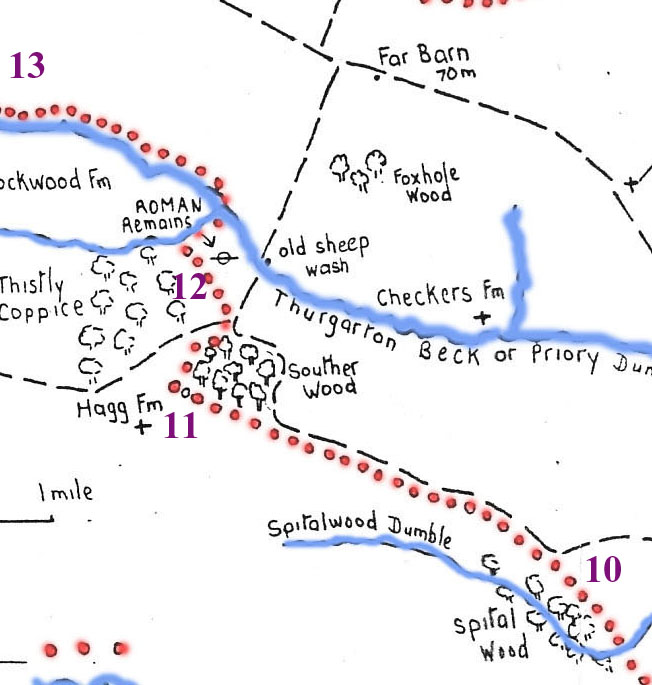
Points 10-13
Point 11 – Walking along this path one follows the boundary hedge through five fields before the path turns sharply north through Souther Wood whereas the boundary passes around the far edge of the wood. The footpath continues down to the sheepwash bridge but the boundary line runs around Woodmeadow to reach the Thurgarton Beck
Point 12 – Woodmeadow contains a small Roman villa as does the small field immediately to its north-west over the boundary in Epperstone parish. Both villas were excavated in the 1950s.
Excavations in 1956 Woodmeadow villa
Point 13 – The boundary follows the course of the Thurgarton Beck which becomes an increasingly steep sided ravine as one follows it north –westwards.
Thurgarton dumble
The old trackway from Epperstone to Halloughton crosses the beck at Ladywell bridge. The old threshing barn at Ladywell has been converted into a modern dwelling. Ladywell was originally called Cresswell and appears as such in the early charters of Thurgarton Priory; the canons purchased the spring from the lordship of Epperstone probably to gain control of the major water sources that fed the beck which flowed past their priory.
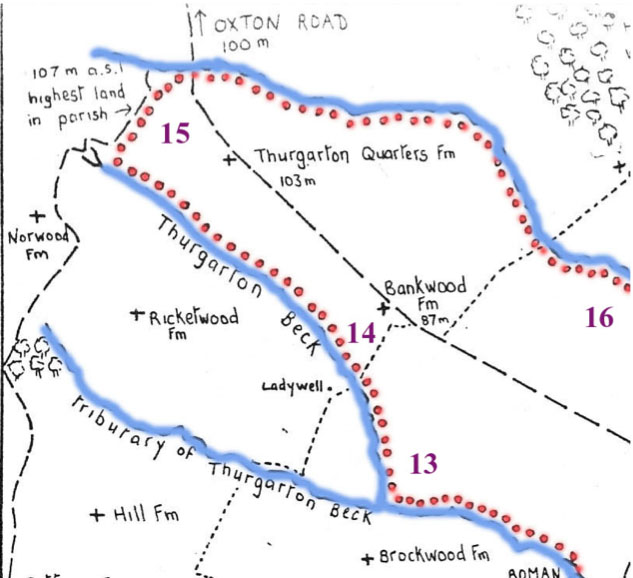
Points 13 to 16 close up
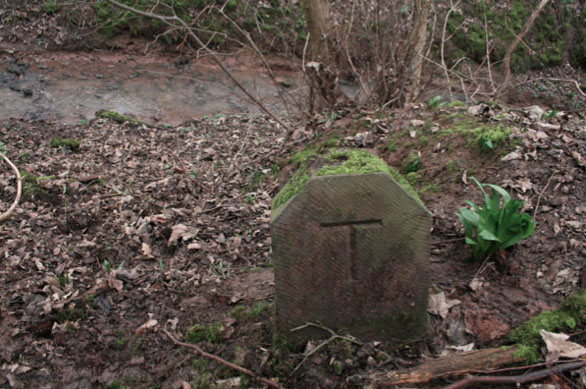
Point 14 – A few yards north of the bridge the diligent searcher will find an old marker stone bearing a large T for Thurgarton. It lies half way down the slope of the dumble on the Thurgarton side; take care it can be very muddy here so avoid times when the beck is in spate. The boundary continues along the Thurgarton Beck until it turns sharply westwards.
T for Thurgarton
Point 15 This is the short northern edge of the parish just below Hollybeck Nursery. There is a footpath immediately north of the boundary hedge which comes out onto the old trackway that runs up the spine of Thurgarton parish from Thurgarton village to the Oxton Road. The boundary hedge is banked and ditched along this short stretch and may be the remnants of a deer fence for the Norman park at Thurgarton.
Points 16 and 17 – The boundary crosses the trackway and turns south-eastwards to follow the Halloughton Dumble for over 2 miles before finally crossing the main A612 at Bougie Bridge – our starting point and so completing the circuit.
Points 16 to 17 close up
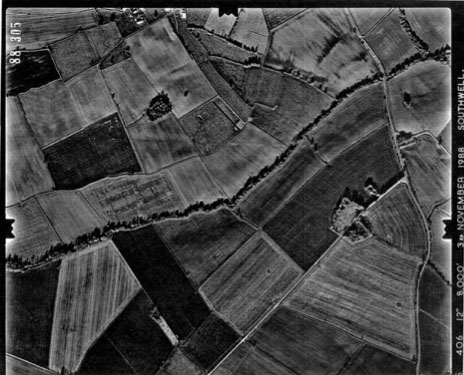
Aerial photographs (from the 1950s) of the final field by the main road show a raised bank or trackway paralleling the Dumble ; this is now completely ploughed out but may have been another boundary bank or deer fence.
Aerial photo point 17
The basic parish structure of England is very old; it was certainly established by the 10th century and may date back to much older land boundaries. The parishes immediately to the east of Thurgarton are recorded in a land charter of 956 AD when King Edwy granted Southwell and the surrounding land to the Archbishop of York; as with Thurgarton, streams, dykes, hedges, trees and trackways were used to delineate the boundaries.
Beating the bounds today
Unfortunately most of Thurgarton parish boundary is on private land and only a few stretches can be walked by the public. The map below shows those locations where the boundary is crossed by public roads or paths ( green stars) and those few sections where a path or road follows the parish boundary ( green line).
Parish map – public access
Sources
Rev A M Y Baylay, ‘Summer excursion 1903: Gonalston church’, Transactions of the Thoroton Society, 7 (1903)
Boots Archives, Record of excavations of Roman building in 1950s at Woodmeadow, Thurgarton
Des Holden of Priory Park, Thurgarton – geography teacher, map maker and gentleman
P. Lyth, G. Davies, ‘The Southwell Charter of A.D. 956’, Trans. Thoroton Society (1992), pp. 126-9.
Rev. H.L.Williams, Bleasby and its History, The Newark Advertiser, (1897), p.5.
Trinity College Cambridge Archives , Box 37, Item 11, Manorial Court records 1547-62
In 1820 Col. John Gilbert Cooper Gardiner sold the Thurgarton estate which had been in his family since the supression of the Priory in 1538. His great grandson, Lt. Cecil Gilbert Cooper R.N. visited Thurgarton in 1869. The young man described his visit in a letter to his father before leaving England to serve on HMS Glasgow the flagship of the British East Indies fleet in 1871/2. In 1873/4 he transferred to HMS Vulture which patrolled the east coast of Africa on anti- slavery duties. His sister, a Mrs Benson of Bray, Berks sent a copy of her brother’s letter to the Reddan family who lived at Thurgarton Priory in the 1930s :-
Here is a copy of my brother Cecil’s letter written to my father about his one and only visit to Thurgarton in 1869. It was my brother’s ambition, if and when Thurgarton was in the market again, to be able to buy it back, but alas he died 5 years after his visit to Thurgarton aged 22 yrs from an East African fever caught whilst pursuing slave dhows. He was a very brilliant young fellow who had won 3 first classes in the Navy examinations and was sent for to the Admiralty and congratulated.
Copy of portions of a letter written by Lt. Cecil Gilbert Cooper RN to his father, the Rev. William Wright Gilbert Cooper describing his visit to Thurgarton in August 1869.
Having heard my father speak of Thurgarton Priory with much interest as an estate which not very long ago belonged to our family, I was very desirous not to leave England again without seeing it and to gratify my curiosity. We arrived in Thurgarton station at 11.30 and were on the look out for the first glimpses of the village – we were pleased beyond our expectations. Lying between two hills, beautifully wooded with lofty and ancient trees with every here and there a cottage showing and glimpses of the old tower of Thurgarton church peeping out between the trees on the side of the hill – it was a most peaceful scene worthy and characteristic of dear old England.
Thurgarton church tower amongst the trees on a frosty morning 1996
As we stepped out of the train an elderly gentleman with a white beard and moustache got in. When the train started we enquired who he was and were told it was Mr Milward. We rather regretted not being able to make his acquaintance for we had heard that he was a very good-natured sort of man. (Note The Milwards had bought the Thurgarton estate from the Coopers in 1820).
By this time it was nearly 12 o’clock and we , not having had anything since 6.30 felt that a little luncheon would not be amiss. We left the station and walking some way down a road and turned left through the village . There were cottages all along the road , clean looking and well kept, with a nice garden in front, here and there a stately tree; the fields being small with numerous hedges giving the country around a very wooded appearance. Opposite to the gate to the carriage road of the Priory stood a newly built school which one of the villagers told us had been built by Mr Milward. Thurgarton is , I think, in a very nice situation- it is less than 3 miles from Southwell, about 10 miles from Newark ; they get the papers from London every day at about 1 o’clock and can get there comfortably in four hours.
We found the village Inn to be the ‘White Hart’ ( a very common name in these parts) and made ourselves very comfortable in the little old parlour where we made a very good luncheon of cold lamb. ( Note The inn is now The Coach and Horses)
The woman who kept the Inn had only been there for a short time and could not give us much information but told me that the Parish consisted of about 4,000 acres, 1500 of which belonged to Trinity College Cambridge together with the presentation of the church, and the remaining 2000 acres originally part of the Priory estate was now owned by Mr Cane a gentleman of property in the neighbourhood. ‘’ However the parish clerk’ she said, ‘ lives next door and could tell you everything you could wish to know about the church and Priory’.We started from the Inn at 12.30 and went to the old clerk’s house and found him and his wife at dinner. We got from him the keys of the church and bade him follow as soon as he could.
We walked down through the churchyard and went into the church through the north entrance. The first thing that I saw were several tablets bearing the name Gilbet-Cooper over the church door. The largest central one was of white and grey marble to John Gilbert Cooper and Susannah his wife; the former died in 1803. On the left to John Gilbert Cooper Gardiner who died 18th August 1822, who I think was my great grandfather, and his wife Catherine who died 14th June 1806. The one beneath is to Dorothea their daughter. The upper tablet on the right is to Susanna Wright Gilbert Cooper erected by her niece Josephine Lysons. The one beneath is to Lt-Col Henry Gilbert Cooper erected by the Rev. Daniel Lysons.
The Cooper memorials Thurgarton church
Whilst we were looking at the tablets the parish clerk came in and on my telling him my name , he became much interested and asked me if my name was Cecil? I answered in the affirmative. ‘Well Sir’ he said, ‘ that is very curious for my ancestors came into this parish with yours as servants of the family. Your ancestor’s name was Cecil and my father has often told me that all our family have been named after him; my name is Cecil , my father’s was and his father before him. We were all servants of the family and when the last Gilbert Cooper left Thurgarton I became Parish Clerk.
After this he evidently took great pleasure in showing us over the church. I could not get much from him about the last of our family who lived at Thurgarton. He said the money seemed to go and nothing to show for it, that they were good easy people , very hospitable and much liked by rich and poor. The church is of the Early English style with pointed arches and carved pillars. The whole was restored about 1860 almost entirely at Mr Milward’s expense. It must have been about this time that the family vault was sealed and the family tablets removed from the chancel to their present position over the northern entrance. The clerk showed us the position of the family vaults which was on the left of the pulpit in front of the chancel steps.
The altar cloth and carpet for the chancel was entirely worked by Mrs Milward and Mr Milward gave at the same time a nice little organ.The seats in the chancel are of very old date and move on hinges , having carved underneath curious representations of friars, evil spirits,etc.
Misericords
One of the most remarkable things in the church was an ancient picture on the north side of the chancel of The Holy Family. The clerk told me it was a painting by Raphael. We asked him how long it had been there? ‘As long as he could remember’ he said and ‘that his father had told him that it had been given by the Coopers many years ago’. My uncle and I were incredulous that this could be a genuine Raphael. ( Note The painting is a mirror image copy of The Holy Family of Francis 1 by Raphael which now hangs in the Louvre).
The Holy Family of Francis 1 by Raphael
We bade the old clerk, Cecil Richardson, good day – it was nice that the old man had such a warm recollection of the family. We walked to The Priory and knocked on the hall door, and giving our cards to the butler and said for what purpose we had come to Thurgarton and that we would be much obliged to Mrs Milward if she would kindly permit us to see the old parts of the Priory. She kindly told the butler to show us all over the house and offered us luncheon, which we declined. The butler led the way into the dining-room where to our astonishment we came upon a life sized painting of the same man as seen in a miniature kept by my Grandmother in her drawing-room in London ( left to her by my late great aunt Mrs Lysons). I immediately asked the butler who it represented? He said it was Colonel Cooper and the picture on the opposite side his wife. Mr Milward had found them in a back room covered in dust and had them cleaned and put up. He heard they were much prized and had been handed down through many generations of the family.
John Gilbert-Cooper
The dining room has a good look out over the lawn and is very tastefully furnished including a beautiful old sideboard having a date 1659 and the drawing room is a beautiful room with a bow out from the centre of the house. The next room on the left is the library where Mr Milward as Magistrate dispenses justice to delinquents doubtless in the same position occupied by the Coopers for several generations. Having seen the old servants hall ( Mr Milward has built a new one) and kitchen we descended to the cellars which are the remains of the Priory as before the Reformation.
The ceiling is curiously groined in arches rising from pillars like leaves from palm trees. The cellars were very capacious and certainly if the monks kept them anything like filled they must have lived in luxury. At the extreme end of the cellar was a small door very solid and strongly bound with iron which we were told was the entrance to a subterranean passage communicating with Horton Abbey – a distance of 3 miles.
( Note As in so many parishes stories of underground passages abound in Thurgarton. This version was said to have linked Thurgaton Priory with a nunnery at Halloughton 3 miles away. There was no such nunnery but a mediaeval prebendary house at Halloughton and a 3 mile passage under rolling hills would have been an engineering feat on a par with today’s Channel Tunnel)
The butler told us that during the church restoration the men engaged with the drainage and heating of the church were continually coming upon foundations of the church and priory – ‘ they must have been of a very large dimensions, more than twice or three times the present size’. He showed us some coloured tiles which had been dug up and said by competent persons to be 3-400 tears old. We could make out the carving of a coat of arms with something like a fleur-de-lys in a shield which resembles the Cooper arms.
The house is of red brick and had it not been thickly covered with ivy would I think be ugly. The butler told us that it had been built about 100 yrs ago and old people in the village had recalled the building of the garden wall. He said the house was not a new one for it was built of the old stone of the Priory but it was modernised and faced with red brick. It is a great pity that it should have happened at that time when taste seemed to have left the world – for from its size and dimensions and the beauty of the adjoining church , it must have been a splendid building. The lawns and gardens are very beautifully laid out. We took our departure when I had taken a rough sketch of the Priory and Church and so we turned our backs on it – to a feeling of regret on my part. ( Note The Georgian house of brick was newly built in 1770s and replaced a stone Tudor house . Both house are built over the cellars or undercroft, the surviving ground floor of the west range of Thurgarton Priory).
Thurgarton Priory c 1930 clad in Ivy
PS My grandmother Mrs Gilbert Cooper when I showed her the sketch of Thurgarton, told me it brought back to her the times she had stayed there when Col. Cooper Gardiner owned it. She told me that there were three (trees) that stood on the left of the house called the ‘Three Sisters’, that the dining room was the lower room of the bow, the drawing room was on the second floor of the bow and that the top room on the right was said to be haunted and was closed up and never used and that the servants were much afraid of going near it.
My grandmother described my late great uncle Col Cooper Gardiner as the most perfect gentleman. She always thought he kept company above his means – that is ; William and his Queen were often there , that the Dukes of Newcastle and Beaufort and various other noblemen were constantly staying with him. She said that Col. Cooper Gardiner had taken my uncle Henry Gilbert Cooper under his care and had declared it his intention to leave the Thurgarton estate to him.
Col. Cooper Gardiner stood for the County of Nottingham , in the Radical interest, and was constantly going about at that time associating with working men and that through this suffered ill health and combined with the loss of Thurgarton, which he was obliged to sell – the mortgages being foreclosed by Mr Milward , the son of his father’s coachman of whom he had borrowed money to stand for the county in which he failed – all brought on the illness from which he died, broken hearted by the thought of having, by his folly, lost the Thurgarton estate which had been for so many years in the family. He was buried at Rodmorton in Gloucestershire in the Lyson’s vault.
My great aunt Mrs Lysons, was left sole executor by his will but she was in great distress owing to the death of her daughter –in-law and so did not go herself to Thurgarton and so many family pictures and curiosities were lost to the family. PS The family portraits were most kindly returned to us by Mr Milward who would not even let us pay for their carriage.
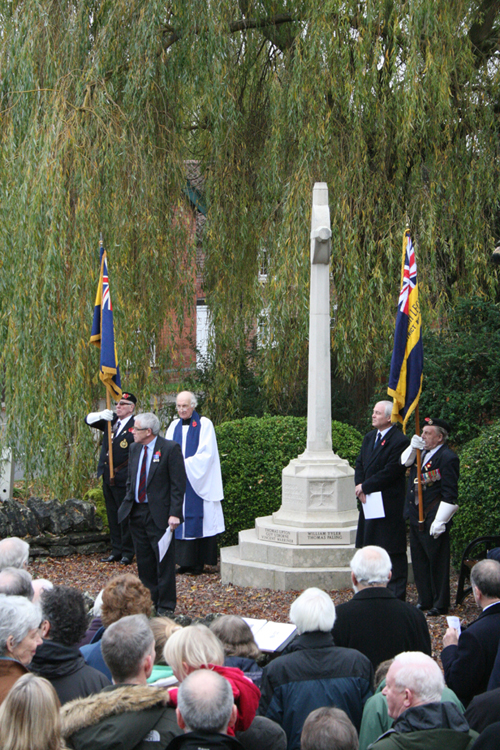
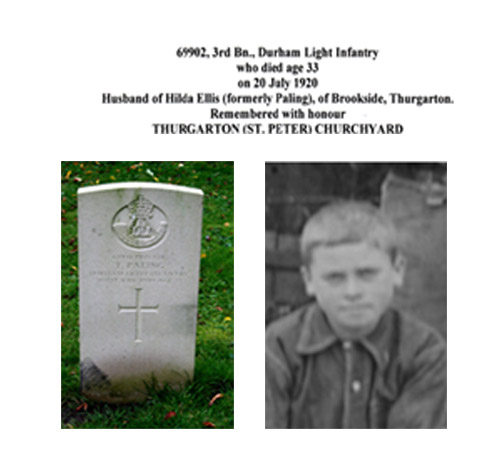
On Remembrance Sunday 2010 the village War Memorial at Thurgarton was rededicated following restoration work. It was erected in 1919 in the old village pound next to the blacksmith’s forge at the central crossroads of the village. It is an impressive cross of white Portland Stone set on a stepped octagonal base on which are carved the names of ten village men who died in the 1914-8 War and two from the 1939-45 War. An additional victim of the first war has been added to the restored memorial – that of Thomas Paling who died from war wounds in 1920.
Rededication of Thurgarton war memorial 2010
Thurgarton men in the 1914-8 war
The census of 1911 shows a parish population of 285 of which roughly 60 young men would have been eligible for active service in the 1914-8 war. The Parish Roll of Honour numbers over 40 names who served, about two in three of the village’s young men.
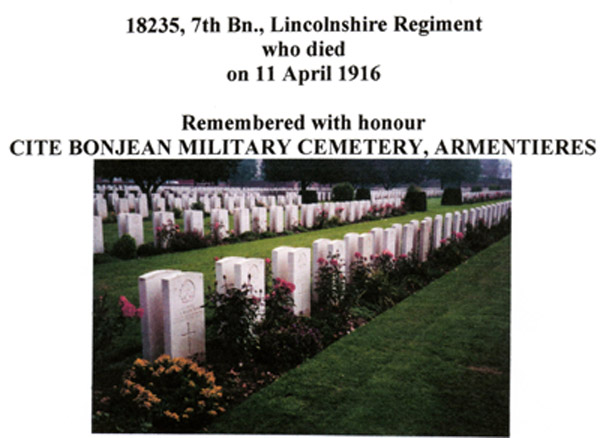
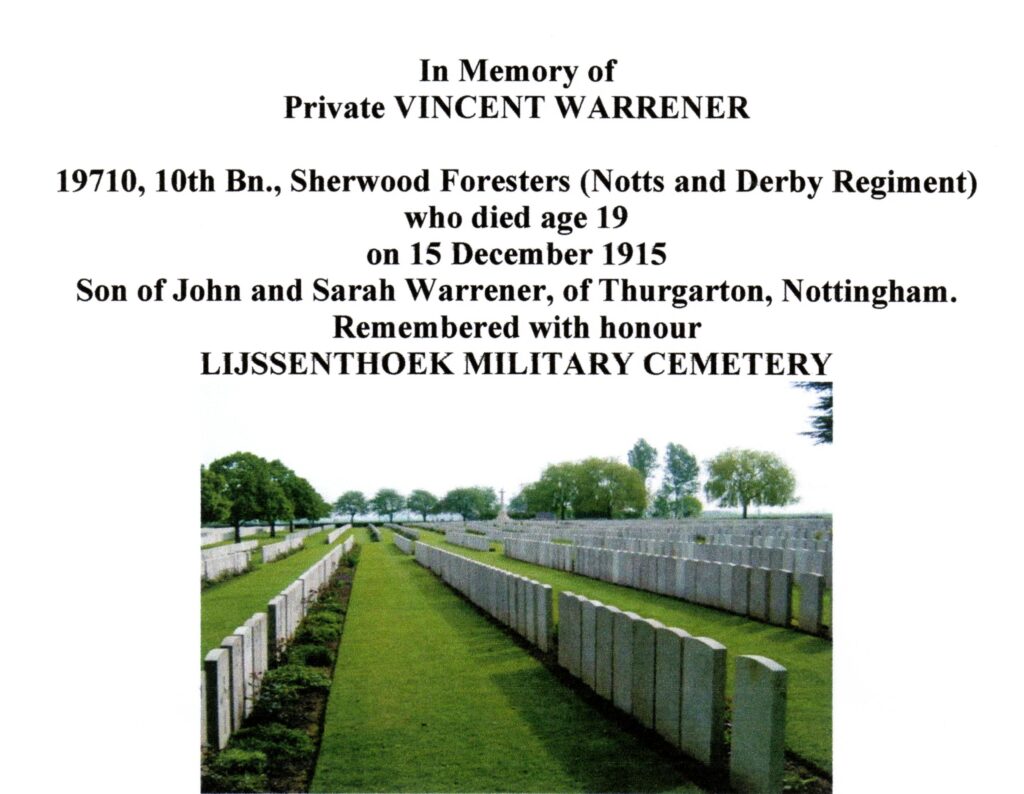
The eleven men who died were : – Charles Baylay, William Bentley, Harry Fisher, Arthur Marson, Thomas Paling, George Smith, Richard Thornton, William Tyler, Thomas Upton, Guy Usborne, Vincent Warriner
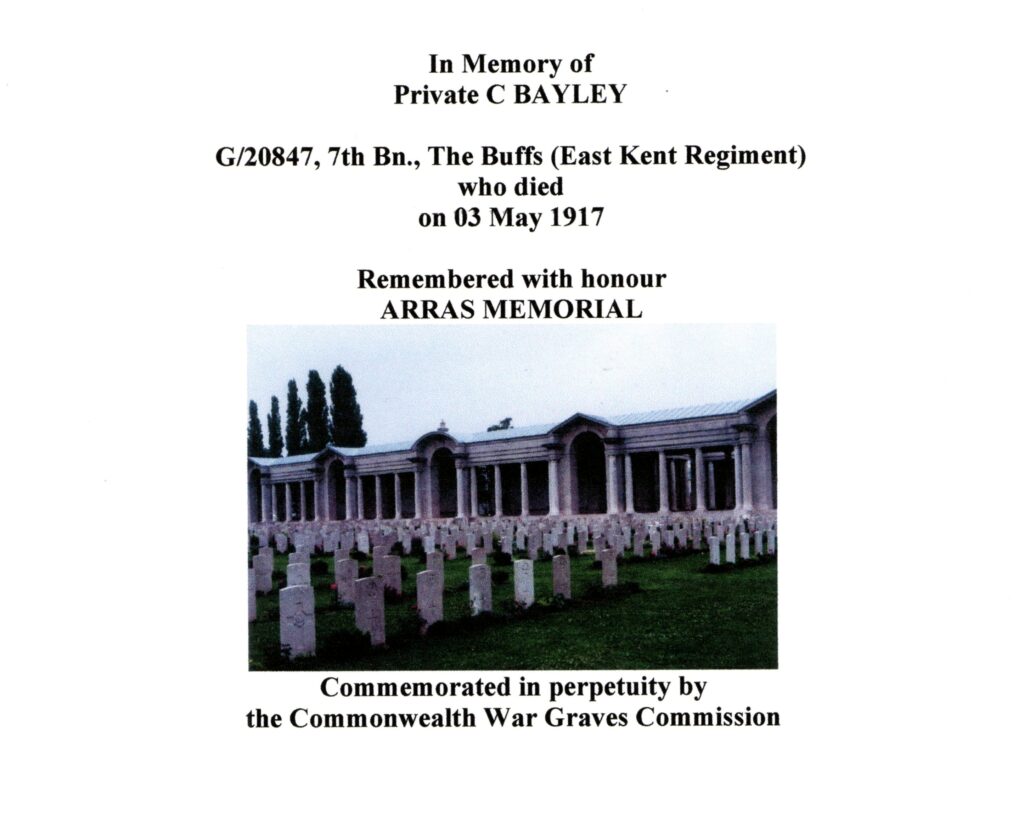
Charles Baylay
Born in 1876 he was the oldest child of Alice and the Rev.Atwell Baylay, vicar of Thurgarton and grew up in the Old Rectory. He moved to Bromley Kent and joined the East Kent Regiment (The Buffs). He was killed in action during the Battle of Arras ( 9 April –16 May 1917) when British and Allied troops attacked the German trenches around the city of Arras and although succeeding in capturing strategically important gains, especially the Canadians at Vimy Ridge, did so at the cost of over 120,000 British casualties.
John William Bentley
John William Bentley was born in 1896, the fourth child of Robert and Alice Bentley of Manor Farm. He worked on the family farm until joining the army on 13th March 1915 aged 19 years; after basic training he was posted to the 3rd battalion Rifle Brigade. He was killed in action in the trenches at Hooge during the bitter battle for the Ypres salient on 13th February 1916.
Harry Fisher
Harry Fisher was the third child of Rose and Job Fisher, Railway Station Master at Thurgarton for over 20 years. He joined the 12th Battalion of the Sherwood Foresters which moved to France in August 1915 and was killed in action in the lines at Ypres on the 15th February 1916.
Arthur Marson
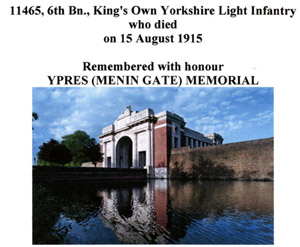
Arthur was born in 1889 the second of three sons to Mary and Charles Marson of Hill Farm cottages. He joined early and was posted to the 6th Battalion of the King’s Own Yorkshire Light Infantry. He was promoted to Corporal but was killed in action near Ypres on 15th August 1915.
Thomas Paling
Thomas was born on 19/3/1887 the fourth child of Elizabeth and Henry Paling, joiner who lived on Bleasby Rd. We have little detail of his war service but we know that he joined the Durham Light Infantry and was severely wounded in France. He died on 20 July 1920.
George Smith
We have no further details on Private G H Smith.
Richard Thornton
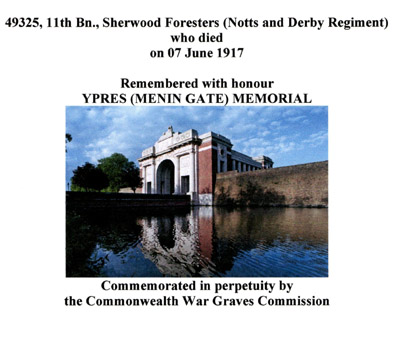
Richard Lacey Thornton was born in 1888 the fifth child of Emma and Richard Thornton, farmer at Old Farm. He joined the 11th Battalion Sherwood Foresters and was killed in action on 7th June 1917. At 3.10 that morning the battalion went ‘over the top’ on the far left of the British mass attack on the Messine Ridge
William Tyler
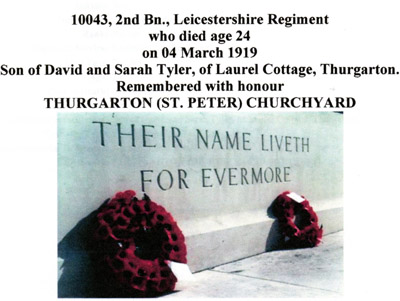
William Tyler born on 22/4/1896 was the second child of Sarah and David Tyler, farm worker who lived at Laurel Cottage, Thurgarton (demolished for Corner Croft bungalows). He joined the 2nd Battalion Leicestershire Regiment at the outbreak of war. In August 1915 he was severely wounded (a gun shot to the abdomen) and was shipped home for convalescence. In 1916 he embarked for Basra as part of the ill-fated Kut campaign but came down with malaria. Having survived all this he sadly fell victim to the Spanish flu epidemic and died at home on 4th March 1919.
Thomas Upton
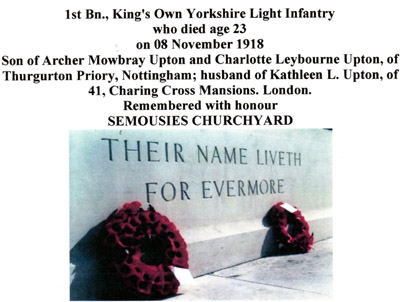
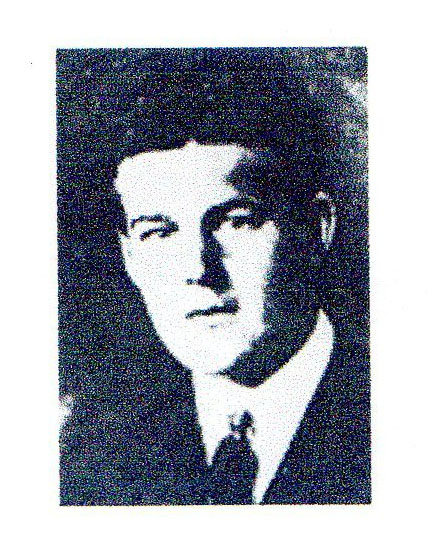
Mrs Upton of Thurgarton Priory lost two grandsons in the war, both are commemorated on the village war memorial. Captain Thomas Upton and his parents would have been houseguests at The Priory. He joined the 1st Battalion King’s Own Yorkshire Light Infantry and was killed in action a mere 3 days before the armistice. The regimental diary states that he was killed in fierce fighting as the battalion attacked Douriers and the Avesnes Road. His grave is one of three war graves in the small churchyard at Semiouses.
Thomas Richard Guy Usborne
Sub-lieutenant Royal Navy Born on 9/10/1900, Guy Usborne would have lived at Thurgarton Priory for some of his youth – his parents and grandmother (Mrs Upton) lived there before and during the war. The Usborne family had a strong naval tradition and Guy served as a junior officer in the British Baltic Fleet fighting in 1919 alongside the Finns, Estonians and White Russians against the Bolsheviks. On 18/8/1919 he joined a small squadron of fast Coastal Motor Boats which attacked the naval fortress at Kronstadt – two battleships and a submarine were sunk but he was one of several casualties and was mentioned in dispatches.
John Vincent Warriner
John Vincent Warriner was born in 1897 the first child of Francis and John Warriner, postman who lived on Bleasby Road. On leaving school he became a farm worker and joined up early after the outbreak of war. He joined the 10th Battalion Sherwood Foresters which shipped out to France in July 1915. In December 1915 the regiment was in the lines near Ypres on the Menin Road. Both sides suffered heavy bombardment during the first weeks of December with a steady stream of casualties. Vincent was one such casualty and died of his wounds.
Those who survived
Ainger G, Sherwood Foresters, Ainger A, Notts Hussars, Baylay John, Royal field Artillery (Old Rectory), E Francis, Royal Engineers , Bird Henry, Royal Garrison Artillery (Beck St), Featherstone William, Royal Field Artillery(Hill Top cottage), Featherstone Arthur, Sherwood Foresters, Fisher George, Coldstream Guards(Railway Stn ), Fisher Alfred, Sherwood Foresters , Fletcher Leonard , Sherwood Foresters (Coach + Horses), Francis John Ernest, Royal Marine Artillery, (Butt Lane), Francis Sidney James, Sherwood Foresters –wounded, Francis Bernard Radford, Australia Contingent – wounded 4 times, awarded Military Medal, B.A. Francis, West Africa Rifles, Heather Robert , Sherwood Foresters, Hunt George, Rifle Brigade (Beck St), Killick Walter, Rifle Brigade –wounded (Priory Gatelodge), Marsden C, 17th Lancers (First House), Marson John, Royal Field Artillery – wounded (Hill Farm), Massey M, Sherwood Foresters, Mott Herbert, First Class Boy, Royal Navy (Bleasby Rd.), Paling Fred, Army Service Corps M T,(Bleasby Rd), Richards Edward, Canadian Division, Richardson Frank, Seaman, Royal Navy(cottages by Coach and Horses, now the kitchen), Scrivener G, Royal Navy Volunteer Reserve, Taylor Edgar, Royal Garrison Artillery(Checkers cottage), Taylor Harry, Royal Marine Light Infantry, Taylor Arthur, First Class Boy, Royal Navy, Taylor G, Leading Seaman, Royal Navy, Thornton Noel, Sherwood Foresters – wounded(Old Farm), Tyler Arthur, Army service Corps and Sherwood Foresters – wounded (Laurel Cott –now Corner Croft), Warriner William, Royal West Kents – wounded (Warriner’s cottage)
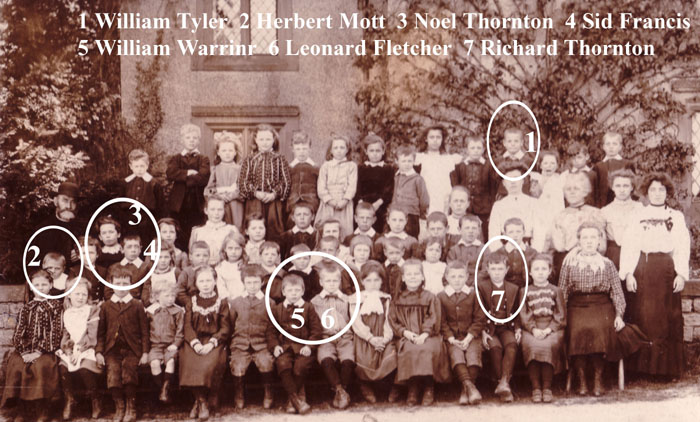
Putting faces to names
This early school photograph of 1905-6 contains many of that generation of young men destined to fight in the 1914-8 war. Those who can be identified have been highlighted in the photo.
Bernard Francis
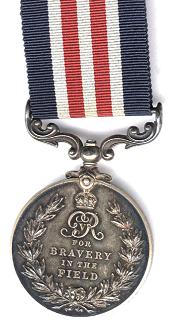
Born and raised in a large family in Thurgarton where his father was a railway signalman. Bernard emigrated to Australia c 1910 and joined the Australian forces at the outbreak of war. He was posted to France with the 4th Australian Brigade who were involved in heavy fighting during summer 1916 at Pozieres and Mouquet Farm ( called MooCow or MuckyFarm by the troops). He was awarded the Military Medal.
The commendation reads :- “ Near Mouquet Farm. For splendid work as a Company Runner between 13th-16th August 1916. During a night attack on 14/15th August he insisted on running in front of his Platoon Commander to shield him and act as a bullet stopper. Later with total disregard to danger he carried by himself several wounded men from the enemy trench back to our lines. He moved about continuously under all kinds of fire bandaging and carrying in wounded for 4-5 hours and finally brought in a message into Battalion headquarters through a heavy barrage”
Thurgarton men who died in the 1939-45 War
Sergeant Jack Allwood D.F.M.
Sergeant 633511 160 Squadron RAF Gunner Born in 1920 he lived at Holly Cottage on Priory Road. Jack was shot down near Tobruk on 26/9/1942 aged 20 years. A tree now stands in St Peter’s church graveyard in memory of Jack – it was grown from a seed of a pine tree that once stood in Ramleh War Cemetery near Jerusalem where he was buried.
Geoffrey Fletcher
Private 5052596 2nd Airborne Division South Staffordshire Regiment. Born in 1917 he lived in Wyer’s Cottage on Beck Street. He was killed in action in Sicily on 9th July 1943 aged 26 years and is commemorated on the Cassino memorial, Italy.
Roll of Honour World War 2
William ‘Bill’ Atkin joined up in 1939 A Company Sherwood Foresters Captured in Norway campaign and spent rest of war as POW. Came home in 1946
Kathleen Atkin ATS
Ernest Bentley joined up 1939 A Company Sherwood Foresters Served in Norway campaign
John Bentley joined 1939 served with Tank Regiment in France
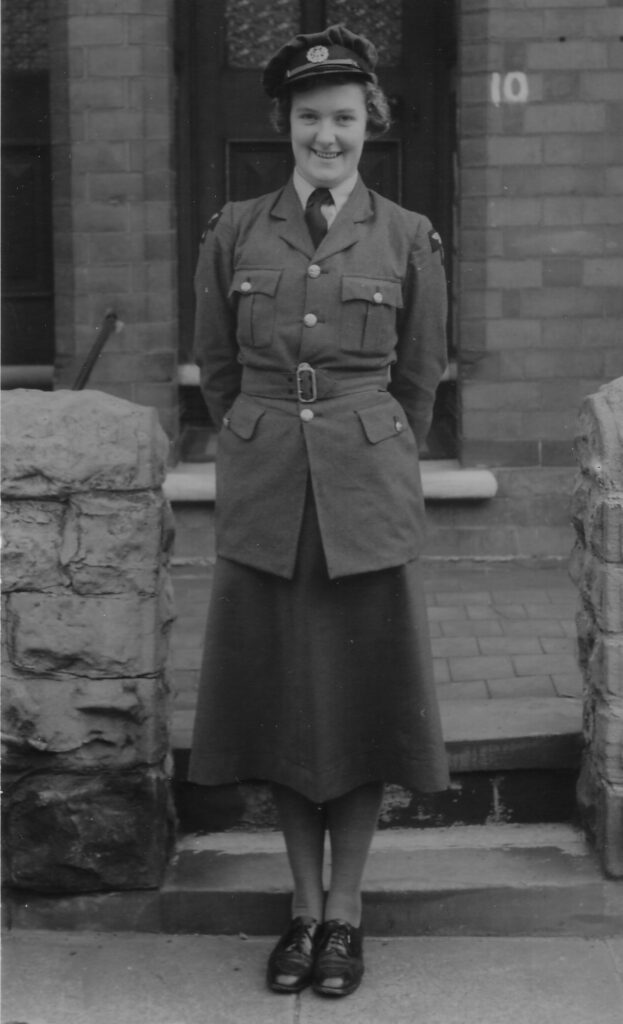
Hilda Bentley Sgt, WRAF served at RAF Cranwell
J Banton lived in The Park
D Banton
John Bowley joined 1939 A Company Sherwood Foresters
George Bowley joined 1939 A Company Sherwood Foresters
Grant Burgon son of licensee of Magna Carta Lowdham. Lived in Appletree Cottage Beck St.
Hilda Bowley ATS
Ernest Crowder joined 1939 A Company Sherwood Foresters but mumps prevented service in Norway.
Sid Crowder Home Guard where he learnt Morse Code and signalling so on call up in 1943 was posted to The Royal Signals. Served 1944 to 47 in India and Malaya
R Farrands Royal Medical Corps served in India.
Jack Holmes Territorial Army, oldest of six boys who lived on Beck St.
Bernard Holmes Royal Artillery served in India and Berwick Garrison
Wilfred Hornbuckle joined 1939 A Company Sherwood Forresters, served in Norway.
Les Lovett joined up at 17 into Sherwood Forresters served in Europe but legs badly injured by mortar shell, leaving him with a life long limp
H Massey family had threshing machine and lived in old cottage on Beck St
Edward Marsden Sherwood Forresters but too young for Norway, lived in First House
Doug Marsden long service in army in India in 1930s
Cyril Marsden oldest of Marsden boys became career soldier and obtained senior rank
Geoff McLean oldest of 6 children in Gate Lodge became Lieutenant in Army, served in Palestine.
A Morris son of licensee of Coach and Horses pub.
Robert Richardson
Jack Reeve Asthmatic but passed fit for Navy – two years at Portsmouth.
Arthur Sharp TAs and then joined Sherwood Forresters at 17 – too young for Norway. Lived in Beck St.
Harold Statham village shop
Robert Scrivener RAF served in Iceland.
Nelly Scrivener WRAF sergeant
Eric Scrivener
Percy Warriner
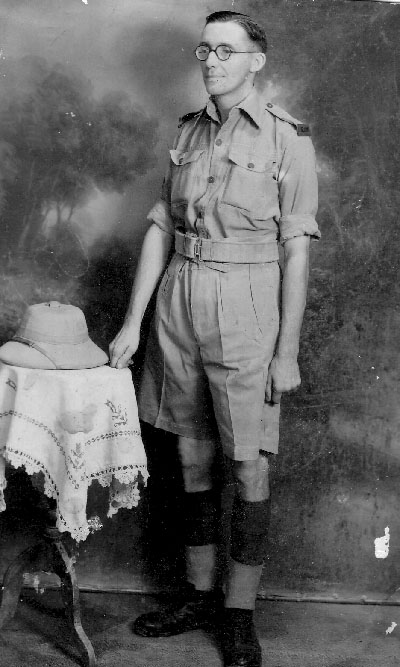
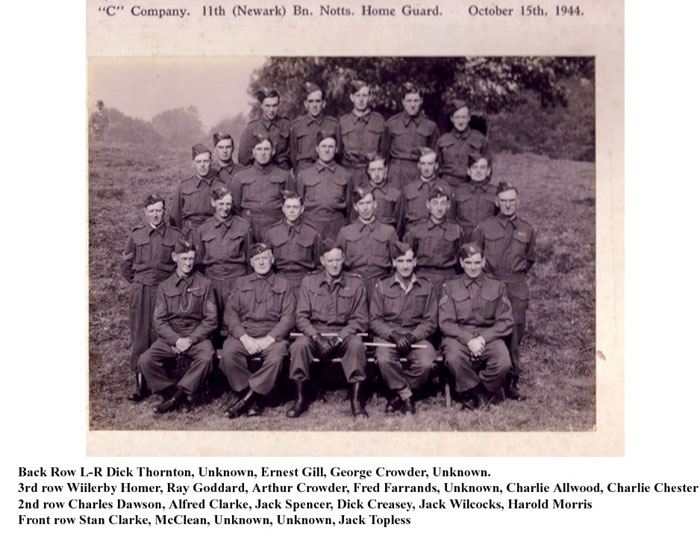
The Home Guard
The Home Guard at Thurgarton, about 20 men, drilled at The Hut, an old World War 1 barracks hut which stood on the present village hall site. Amongst many duties they mounted a 24 hours guard at the Railway Station.
In the year 1505 the Prior of Thurgarton enclosed 6 acres of common land in Thurgarton parish for use as sheep pasture. The Prior urgently needed cash to meet the taxes imposed by Henry VII and wool was more lucrative than arable farming; the records state that the resulting loss of land to the plough team of six men caused considerable distress. This story is typical of the history of land enclosure in England, of centuries of dispute between landowners and local farming communities who struggled to preserve their ancient landholdings and common rights.
Land enclosure is reported in every century of the mediaeval and early modern era but it was in the 18th century that it came to a climax. This wave of enclosure was due to several causes but two major factors were the need for more efficient farming methods to feed a rising population and the rise of the free market in farming and speculation in land.
Thurgarton has no record of formal enclosure awards or maps but two parish surveys from 1745 and 1777 provide some insight into enclosure and changes in farming in the parish.
1745 survey of Thurgarton
In 1745 Trinity College Cambridge commissioned the land agent Teals of Leeds to survey their Thurgarton estate.
Thurgarton parish c 1730 –45 Cooper land in blue, Trinity College estate white
The surveyor, Mr Ransom, reported that the college fields ‘are very good so as to bear not only Clover, Turnips, Wheat, Barley, Peas, Oats and Hay but also Flax and Hops’. In contrast most of the 1,744 acres owned by the Cooper family in the northern half of the parish was ‘ heavy clay, wooded and rough land’.
The Coopers had from Tudor times leased the College estate which in turn they sublet to the local farmers. In this 1745 survey the village farmers complained that’ Mr Cooper grants leases to the tenants for 7 years at back rent and at the end of that term every tenant pays 1 years rent over and above before Mr Cooper will grant him another new lease. The farmers declare that but for the college lands they would not rent Mr Cooper’s land which is inconvenient and of a bad nature and of little worth’.
The College owned nearly 800 acres in the southern half of the parish. By 1745 the pasture and meadows of the College’s land had already been enclosed and were rented to the village famers and smallholders at 18s per acre per year. Over 600 sheep grazed on the newly enclosed fields. However 111 acres of the old open field plough lands persisted and were still worked in common in elongated strips, called lands or selions in the village records; these were rented for 8s per acre plus 3s per acre tithes.
The College also owned all the village plots, cottages and farms. The 1745 survey notes that many of the cottages and outbuildings in the village were’ out of repair and some of the barns and outhouses were fallen down’. In 1745 the village contained five farmers who rented over 50 acres, several who worked 10-50 acres and many small holders renting under 10 acres.
Figure 1 Acreage rented by Thurgarton households 1745
A third of households (yellow column in figure 1) rented less than 1 acre which consisted of a garden and orchard around their cottages; amongst this group were a few artisans, a school master and several elderly inhabitants of alms houses.
1777 Beighton’s survey of Thurgarton
Beighton’s map of Thurgarton parish 1777
By 1777 the whole of the parish was enclosed – the once large fields, meadows and woodland were now divided into multiple smaller fields and all were rented out to local farmers both great and small.
Changes in the Cooper estate
In 1736 John Cooper of Thurgarton Priory died without children. The estate passed to his cousin John Gilbert of Locko Park, Derbyshire who adopted the Cooper name on inheriting the property. He sold his Derbyshire estate and began a programme of improvement in Thurgarton which was continued by his son and grandson (both also named John Gilbert Cooper). The old Tudor mansion and monastic kitchen were demolished and replaced by a brick built Georgian house with newly landscaped grounds, scenic lakes joined by waterfalls and weirs and a walled kitchen garden.
Georgian mansion
They also transformed the ‘rough and inconvenient lands’ of the Coopers into highly productive farms. Between 1745 and the 1770s the scrub and woodland were cleared, the heavy clay land was drained and ditched, and new fields were laid out separated by thorn hedges. Handsome new farmhouses were built along with outbuildings and threshing barns
Magadales and Hill farm houses
This newly drained heavy soil was ideal for grain. Eight large threshing barns date from this period; built of local skerry stone they are dramatic reminders of this age of agricultural improvement.
Four of the eight new threshing barns in the north of Thurgarton parish
The large central archways allowed a fully laden wagon to pass straight through the barn emptying its load onto the central threshing floor paved with large flagstones. The massive doors were set on elevated door jambs which left a large gap under the closed doors for ventilation.
Old threshing barn doors on elevated footings – the 2 foot gap under the door has been filled in
Four new northern farms were rented to tenant farmers from outside the parish community– in 1777 John Newham of Magadales farmed 257 acres, William Wilkinson of Hill Farm 251acres, Samuel Flint of Thurgarton Quarters 209 acres and Thomas Dufty of Bankwood 130 acres.
Cooper estate 1730, 1777and 1850
Typical of the many English post-enclosure farms, each farmhouse was sited centrally within its fields and geographically isolated from the village. Farm servants and domestics initially lived within the farmhouse and outbuildings. By the mid 19th century the northern half of the parish contained five compact farms (with the addition of Checkers Farm ), each with its adjacent tied cottages built for the farm labourers.
Changes in the College estate
By 1777 all the college land including the old strip plough lands had been enclosed bringing to an end over eight centuries of the old village farming system.
Figure 2 1777 land rentals of Thurgarton villagers
According to many historians enclosure led to the division of rural parish communities into four groups – the landowners, large farmers , small farmers and lastly a mass of landless wage dependant labourers. How well does Thurgarton fit this picture ?
GentlemenJohn Gilbert Cooper of Thurgarton Priory was the local squire and main landowner and leaseholder of College land. By 1777 farmer John Brettle of The Manor House (now the Old Rectory) was described as a gentleman, he both owned and leased over 200 acres of Thurgarton land which he sublet to his neighbours.
Large farmers Six larger farms emerged each working 50 to 150 acres. John Hart senior (The Hollows) and J Hart junior (Old Farm) farmed over 200 acres between them. William and Thomas Farrand of Priory Farm rented 105 compact acres. Thomas Green of Manor Farm rented 140 acres and next door was Jeremiah Hinde who worked 106 acres. Henry Smith of Orchard Farm, Bleasby Rd rented 68 acres The fields of these village farms were scattered through the parish – a remnant of the pre-enclosure pattern of landholdings. Over the next century three of the farms come to dominate the village scene –Priory, Manor and Old Farm – but even into the 20th century their fields were far from compact and herds of cows, wagon teams and harvesters criss-crossed the village roads and tracks.
1777 large village farmers in Thurgarton
The 1777 survey omits a detailed description of the farms but a tour of the present day village provides several examples of new building in this period – Manor Farmhouse, the barn at The Hollows enlarged by John Hart senior in 1775 and the 1790 threshing barn at Old Farm by J Hart junior. Throughout the village one sees older stone barns being enlarged with brick extensions – some are Victorian but several date from the 18th century.
Manor farmhouse
Small farmers Thirteen farmers held 10 to 30 acres and nine 5 to 10 acres.
Thurgarton 1777 – 23 small farmers
Over 60% of the village households rented between 5 and 30 acres. Many households who rented less than 5 acres in 1745 had doubled their acreage in 1777, eg. the schoolmaster George Huddlestone who in 1745 rented a small garden and school house has 5 acres to his name in 1777. Again we see a wide scattering of fields, arable and pasture, rented by the smaller farmers. The larger units would have kept the farmer and his family fully occupied but the very small scale tenant may have supplemented his income by working for his larger neighbours.
Landless wage earning agricultural labourers The survey lists only three households who rent a cottage and garden with no land. Where then are the landless poor in this survey? The map of the village does not include the alms house shown on the 1730 and 1799 maps. The 1777 survey may be incomplete although it includes 39 households compared to 40 in 1745.
If this survey is truly representative there was no great mass of landless wage dependant farm labourers in Thurgarton village in 1777. The situation may have been very different for the four new northern farms where large tenant farmers would have presided over an army of farm servants.
Conclusion
The increased landholdings of the vast majority of villagers in 18th century Thurgarton is contrary to a post-enclosure picture of dispossesed pauperised labourers. In the process of enclosing its Thurgarton estate, Trinity College, whether from altruism or good business sense, appeared to have ensured that even their poorer tenants in the village had access to sufficient land to make a living (which of course also enabled them to pay their rents and tithes to the college).
The next article will look at Thurgarton surveys in 1799, 1813 and 1842 and the fate of the village farming community. How would the village farmers cope with the challenge of a free market – under the old system they were part of a close knit mutually supportive paternalistic community but now they had to adapt to a cold commercial capitalistic world.
John Byng, fifth Viscount Torrington, toured extensively on horseback through England and Wales in the 1770-90s and published several volumes of diaries of his travels. Old houses, churches, castles and ruins in general attracted him and on his visit to Thurgarton in 1789 he found the somewhat dilapidated church to his liking but he was highly critical of the adjoining mansion (built in 1777).
In his journals he deplored the laxity of the Anglican clergy which he contrasted with the enthusiasm and spirit of the early Methodists. He bemoaned the loss of the ‘old church music’, of the church bands and choirs, and in each village and town he made this a particular point of enquiry. Sadly Thurgarton church confirmed his worst fears but at Southwell Minster, later that day at Evensong, he was astonished by the fine quality of the organ music and the choir’s singing.
Below is an extract for Monday 8th June 1789 at the farthest point of the circular route he took from his lodgings at Newark on his horse Phoney.
—My Pleasant Road brought me to the Village of Rowleston , thence to Fiskerton on the Rivers Bank—where were many Anglers employ’d in Chubb catching; and so by Notown, to Thurgarton, where I hoped to have found some Remains of The Priory of Benedictines. Passing thro’ the Village, I came to The very old Church, and seated myself, in much contemplation, and Quiet, for half an hour, in the Church Yard; till the Clerk arrived.
Thurgarton church and church yard, sketch Builder Magazine 1903
About 15 years since Mr Cooper chose to build his new house upon the old Spot; taking infinite Trouble, as the Clerk told me, to overturn any remaining Ruins.—Now let me appeal to any man of Taste, if necessary, or to any Man of no Taste, by way of Remonstrance, and ask him whether these Ruins, being left, wou’d not have form’d great Beauties in his Grounds and Gardens? And whether a new House would not have look’d better in another Place than stuck close to the Church, without a Sight of the noble old Steeple?
I had neither Pencil or Paper about me (like a Blockhead) or might have attempted something like a sketch of The Church; and written down a good Inscription abt. Loving and beloved Ruth, and Truth, etc.—This fine old Steeple must soon fall, for it is full of Cracks; but ‘Such Flaws are found in the most perfect Nature.’ It was but lately that a Love of Antiquity was pursued; For myself I am glad, tho’ the Priory was gone, to have seen The Steeple in good time; Shortly, Little of this kind will be left to see. Most of the Church has been pull’d down;—at the Eastern End was found, what The Clerk call’d a desolate Pavement, which was thrown away with the Rubbish; The inside is dark and damp, as the Church Yard Ground has risen considerably.
In regard to the Decay of religious Duties, which every person can remark. The Clerk said (to my regular Enquiry) that Singing had been disused about Six years.—At Botesford, yesterday I made the same enquiry, and found that tho the Psalmody there was on the decline, yet was it tolerably supported by 2 Bassoons, a Clarinet, and a german Flute.—Nothing shou’d be more encouraged as drawing both Young and Old to Church, than Church Melody, tho’ the Profligacy and Refinement of the age has abandon’d and ridiculed it: But were I a Squire of a country Village I wou’d offer such Premiums and Encouragement, (of little cost to myself) as wou’d quickly rear an ambitious, and laudable desire of Psalm-Singing, and put forth a little Chorus of Children; than which nothing is more Elevating and Grateful and Sublime, hearing Innocence exert their little Voices in praise of their Creator. For let Fashion say what it can. Every Ear is more gratified by a chorus of youth, than by the most violent Exertions of Taste.
Leaving Thurgarton I came upon a higher Country, and in two miles to Hallaton, where I walk’d around their Chapel, and survey’d a very old Building opposite, adjoined to the new and neatly-built Farm House. Thence I soon came in sight of The pretty Town of Southwell, and of its superb Collegiate Church; and put up at the Saracens-Head Inn
St. James Church, Halloughton ( Hallaton in Torrington’s journal)
Unlike Viscount Torrington, the Reverend T D Powell remembered his sketchbook on his visit to Thurgarton in 1819, which is fortunate for his writing is difficult to decipher. The extract below is therefore heavily edited being limited to those passages that are both decipherable and make sense. His sketches vary from realistic architectural detail to imagined reconstructions (Southwell Minster) and to romanticised ruins in a landscape (Thurgarton church). Rev Powell’s sketches are the only 19th century depictions we have of Thurgarton church before its restoration in 1854 – they show a church essentially unchanged from that in Samuel Buck’s print of 1726.
Thurgarton church as a romantic ruin –Powell 1819
Southwell Minster with spire on its central tower by Powell 1819
Reverend T D Powell’s visit to Thurgarton in August 1819.
From Southwell SW ascended and at more than a mile came to Horton (Halloughton) a little church up a lane on the right of my road, did not go in, it has two lancet windows in the east front. On the gable at the west end is a modern cupola containing a bell. There seems some Gothic buildings nearby but had not time – from hence to Thurgarton whose noble tower painted with the fine tints of ages comes upon you with fine solemn, venerable and beautiful effect. This tower is the north –west tower and is at the west end of the nave of the abbey church with its front highly adorned with arches and windows in the lancet style of the first Gothic bordering on the Norman.
Detail of church tower, Thurgarton –Powell 1819
The lower part of the west end is a noble spacious west portal in the same style highly adorned with deep receding pillars and moulding
The modern red brick house or mansion of Col. Cooper stands a small distance south he says it was built by his father ( most probably on the site of the cloisters and habitation parts of the convent) who then pulled down the old buildings but that some of the vaults remain. He adds that from foundations lately dug there certainly were two towers at the west end as I and indeed everyone must think. What remains besides of the church is very small, the body of the nave running from the west entrance perhaps not a quarter of its length eastwards and the same portions of its side aisle divided with arches and pillarsform the present church. What I have observed of the remains of these arches is sufficient to prove what a fine and spacious edifice this church must have been. Tis situated in a beautiful valley quite away and retired from the village – it must have been A Paradise On Earth.
Thurgarton Church in its valley setting
On a fine sunny evening standing outside the west end of the church one can echo such thoughts.
The railway came to Thurgarton in 1846. The 1830-40s were the years of ‘railway madness’ when numerous railway companies vied to connect the major towns of Britain. George Hudson the ‘Railway King’ had formed the Midland Railway Company in 1844 and the Nottingham to Lincoln link was part of his ambitious scheme to dominate the railway network of the midlands and the north.
Figure 1 George Hudson
The new line was surveyed by George Stephenson and his pupil Frederick Swannick and followed the Trent Valley from Nottingham to Newark and on to Lincoln. The planned route crossed the flat valley meadows skirting the villages and passing through the western outskirts of Newark.
Figure 2 Part of the initial survey map for the parishes of Gonalston, Thurgarton, Bleasby and Rolleston
Accompanying the map was a detailed list of the fields with the names of the landowners and tenant farmers. Figure 3 lists each field in Thurgarton with the landowner ( Richard Milward or Trinity College Cambridge), the lessees and the ‘occupier’ ( the tenant farmer who actually worked the land); presumably each received some compensation from the railway company but we do not have the details.
Figure 3
Most landowners such as Richard Milward of Thurgarton Priory, saw the new railway as a great opportunity and in addition to allowing the railway passage over his lands also invested in the company which rapidly raised the necessary capital of over £ 400,000 with a promised return of 4.5% on their investment.
Some local landowners objected to the route which on close inspection (see figure 1) would have passed through the middle of Bleasby just north of the Waggon and Horses pub and then eastwards towards the centre of Morton village. J P Plumtree Esq. of Ashwell Hall, Morton was one such objector and insisted that the line be redirected northwards away from his estate.
Opening Day, 3rd August 1846
First train from Nottingham to Lincoln —-
Station Street in Nottingham was festooned with flags and bunting, the band of the 4th Dragoon Guards played popular airs and a vast crowd cheered as with a shrill whistle the first train steamed out of Nottingham at 9.26a.m.on the newly built line to Lincoln. Despite heavy rain enormous crowds had gathered along the route out of Nottingham. Out in the country horses bolted, cows bellowed and sheep scampered away at the sight and sound of the engine; old men stared open mouthed and dumbfounded and young men climbed trees for a good view. The train paused at the new Castlegate Station at Newark before finally pulling into Lincoln at 10.15 am to the sounds of church bells and an enormous throng of cheering spectators. A second train followed 30 minutes later with more VIPs. Champagne and light refreshments were taken before returning to Nottingham for lunch.
— and back to Nottingham for lunch —
Both trains returned to Nottingham where the engine sheds had been laid out for a celebratory lunch. Mr George Hudson MP and chairmen of the Midland Counties Railway drank to the health of the Queen, to other members of the royal family, to the ladies and lastly to the High Sheriff of Nottinghamshire who in turn proposed a toast to Mr Hudson before all promptly boarded the train once again and returned to Lincoln for a public dinner.
— and back to Lincoln for dinner —
Their arrival at Lincoln was marred by the explosion of one of the cannons sounding a ceremonial gun salute – one old gunner suffered such severe leg wounds that amputation was necessary. Undaunted a huge crowd gathered for a banquet at the National School Rooms; the guest list included High Sheriffs, Archdeacons, Lord Mayors, Town Clerks, Coroners, Colonels, Reverends and Right Reverends and Esquires by the dozen.
Mr George Hudson was in fine form and proposed toasts to the Queen, the Dowager Queen, the Bishop and Clergy, the Army and Navy, the Mayor of Lincoln and finally the High Sheriff of Nottingham – Mr Hudson was thanked and toasted by one Archdeacon, two Lord Mayors, one Colonel and a High Sheriff. At this stage Mr Hudson sat down and his deputy took over and proposed and drank several more toasts but by this time who was toasting whom was not clear to the gentleman of the press charged with reporting these great events.
— and back to Nottingham to bed.
All boarded the trains for the return journey to Nottingham and the end of a heavy day.
The heavy rainstorms of the 3rd August had tragic consequences; part of the railway embankment at Gonalston Crossing had washed away and sadly, on the following day, a fireman was killed when a train derailed.
Thurgarton Railway Station
Figure 4 Thurgarton Station House
The railway station at Thurgarton lies about 400 metres south of the village. The original handsome station house is essentially unchanged in external appearance; it was designed by architects C E and T A Davies who employed the same style for most of the stations on the new line – a style described by Pevsner as neo-Tudor but by others as ‘Gingerbread’.
Initially four trains a day ran in either direction; the journey from Thurgarton to Nottingham took about 40 minutes and to Newark 20 minutes. Fares per mile were 3d first class, 2d second class and 11/2 d third class and livestock cost 5d per mile for horses, 2d per mile for cows and ½ d per mile for sheep.
Figure 5 Early timetable for trains through Thurgarton
Station master and staff
Even in a small village such as Thurgarton the railway station employed several men from station master to clerks and porters and a strong tradition of railway families developed with sons following their fathers in working on the railway. Mr James Hewitt was station master in the 1850-60s and lived in the station house with his wife Harriet and two children -his son became a railway clerk. Mr John Kind was station master for 32 years, he and his wife Elizabeth raised six children in the station house one of whom worked as a porter.
Figure 6 Mr Kind, his wife and six children and several other staff on the platform of Thurgarton station, about 1881
On their retirement in 1898 Mr and Mrs Kind were presented with a clock and a chair for 32 years of ‘ able and courteous service’ to the villagers of Thurgarton; sixty householders signed the vote of thanks headed by Bishop George Ridding who lived at Thurgarton Priory.
Figure 7 Mr and Mrs Kind on their retirement 1898
Mr Job Frederick Fisher followed in the 1890s and served as station master until 1921. He and wife Hannah raised eight children, six of which worked on the railways. The impressive size of these railway families suggests that the popular romantic notions of steam engines and railway stations are well based.
Effect on village life
We know from contemporary accounts that people’s reaction to the coming of the railways varied from doom laden fears to wild enthusiasm.There can be no question that the new transport system was a significant factor in the increasing wealth and mobility of Victorian Britains. Thurgarton shared in this; for an agricultural community the mass movement of grain and livestock was vital for the larger farmers but for the many smallholders of the village it was the sale of vegetables, eggs etc in the markets of Nottingham, now only 40 minutes away, that generated that extra bit of cash so important to their well being.
The opportunity of increased mobility over greater distances accelerated the preexisting pattern of movement of rural to urban communities but there is no evidence of a massive depopulation in Thurgarton where census returns from 1841 to 1851 show a modest growth in village inhabitants and for the rest of the century a modest decline from about 380 to 320. A study by O’Neil et al of mobility of Thurgarton inhabitants from 1841 to 1881 suggests that nearly half the village householders changed each decade; there was evidently much coming and going in this period and the railways must have been a factor in this mobility. Their study did not look at earlier pre-railway centuries and a brief study of village names from the 17th and 18th century suggests a much more stagnant population.
Railway outings to choral and flower festivals become a regular feature of the social calendar as did the annual Sunday School outing to Skegness or Mablethorpe – an occasion which continued up to the 1970s.
Figure 8 Thurgarton Methodist Sunday school outing 1930s
The coming of the railways provided generations of boys with a new pastime and for trainspotters young and old here are two old steam engines at Thurgarton.
Figure 9 and 10 Trains at Thurgarton 1920s
Sources
R Lelleux (ed.) A regional history of the railways of Great Britain Vol 9 The East Midlands, David and Chambers (1976).
The Nottingham and Newark Mercury, 4th August 1846.
Thurgarton village archives – census, photographs , maps.
J. O’Neil et al, Nottinghamshire Family History Journal, Vol 6, no 8, pp17-20.
Personal communication on railway station Mr David Yates, Thurgarton.
I’m grateful to Mr Glynn Waite for details and photographs of Mr Job Fisher and his family and to Mr Fisher’s great-great grandson, Clive, for permission to publish the photograph .
This article explores the origins of the Augustinian Priory of St.Peter at Thurgarton.
Figure 1 Reconstruction of the Priory Church, Thurgarton
There are two foundation charters for Thurgarton Priory but neither contains an exact date for the birth of the priory – sometime in the 1130s seems to be a reasonably safe estimate (1). The first charter was issued in the presence of the Chapter of Southwell Minster by Thurstan, Archbishop of York and states that :-‘Ralph Dayncourt, on our advice and counsel, grants to God and the church of St Peter at Thurgarton and the regular canons who serve God there, all the churches of his lands’
The second charter was issued by Ralph Dayncourt, again before the Chapter of Southwell Minster, but after the death of Archbishop Thurstan and reads :- ‘I, Ralph de Ayncurt, for the good of my soul, and the souls of my sons and daughters, my parents, my wife Basilia and all our ancestors, have founded a house of religion at Thurgarton, and grant to the regular canons who there serve God and St. Peter, on the counsel and entreaty of Thurstan, Archbishop of York, of blessed memory, all my land at Thurgarton and Fiskerton, the park next to Thurgarton and all the churches of my lands’.
Central to the founding of Thurgarton Priory therefore were both baron and bishop – Ralph Dayncourt and Thurstan, Archbishop of York, but before examining those two key figures we need to briefly look at the Augustinians and at the church in early Norman England.
The church in early Norman England
Within a few years of 1066, Norman clerics filled all the senior ecclesiastical offices of England (2).The Norman hierarchy of baron and bishop controlled Englishmen both in body and soul; they built new churches alongside their castles, highly visible statements of Norman lordship replacing the old order. The rapid rise of new monastic houses in 11-12th century England can be viewed as part of the Norman ‘programme of conquest’ (3).
The church in England in 1066 was, according to the Pope, in a sorry state and in urgent need of reform (4). The vast majority of clergy in England were married parish priests, mostly uneducated, who had inherited their church living from their fathers; they were the target of 11th century church reformers led by Pope Gregory VII who aimed to replace them with a well educated and celibate priesthood to be ‘holy and separated for the work’ of celebrating the mass (5). The Norman invasion brought into the English church an army of Norman clerics in whose ranks were both ardent monkish reformers and conservative dynastic churchmen who resisted reform and defended the long tradition of a married hereditary clergy (6).
The Augustinian order of regular canons – the black canons.
Figure 2 Detail from miserichord St Peter’s , Thurgarton
The Augustinian order was named after St. Augustine, Bishop of Hippo c. 396-430. Augustine had advocated basic rules for communal religious living but it was St. Benedict c. 480-543 who drew up the detailed set of rules which were to dominate Western monasticism for several centuries (7). These traditional monastic orders were of limited use to the Pope’s reform plan; their strictly enclosed life was a barrier to their effectiveness as agents of change in the wider world; and so was born the Augustinian order – the black canons, an 11th century papal innovation formed as a vanguard of church reform (8). They observed the same offices and basic routines of Benedictine monasteries; they lived communally, shared property and took vows of poverty, chastity and obedience. In contrast however to the enclosed cloistered life of the monks, Augustinian canons were allowed out of their houses to work as parish priests
Most importantly Augustinians were very flexible and cheap to establish and maintain. They occupied a wide variety of sites from larger urban and baronial centres to small rural hermitages (9, 10). This flexibility attracted many founding patrons from the Norman nobility, for the Augustinians could accommodate their varying aspirations and purses.
Ralph Dayncourt’s foundation endowment of Thurgarton Priory was typical of Augustinian houses consisting mainly of parish churches with their livings and only a modest grant of land, in contrast to the land hungry Cistercians. This acquisition of churches relieved the patron of the onerous duty of appointing and supporting a parish priest and achieved yet another aim of the reformers – that of returning parish livings to direct church control (11).
Given all these advantages the rapid spread of the black canons in the 12th century is not surprising but it was royal support which ensured their rise to become the most numerous religious order in England (over 260 houses)(12). The Augustinians first appeared in England about 1095 and by c1135 (Thurgarton Priory’s birth) over 45 new houses had been founded the majority of which owed their establishment to the patronage of Henry I and Queen Maude and a court entourage of barons and ecclesiastics (13).
Thurstan , Archbishop of York
Amongst the new wave of churchmen crossing the channel from Normandy were a married priest named Auger, who had been appointed as a prebend to St.Paul’s in London and his two sons, Audouen and Thurstan, who were both destined to follow as prebendaries of the same church. Audouen eventually became Bishop of Evreux and Thurstan gained advancement as a chaplain in the royal court and was eventually appointed Archbishop of York in 1114 (14). Despite being the product of the old unreformed tradition of hereditary clergy Thurstan developed a ‘youthful admiration for the monastic life’ and took a vow to become a Cluniac monk – which he fulfilled a few weeks before his death in 1140 when he entered the Cluniac monastry at Pontefract (15).
When Thurstan first entered York in the winter of 1114 he encountered an impoverished province struggling to recover from decades of instability culminating in King William’s final suppression of the embers of northern resistance in 1070 (16) . Almost immediately Thurstan faced a challenge from Ralph, Archbishop of Canterbury, who, with the king’s support, pressed for a final settlement of Canterbury’s claim to primacy over the Archdiocese of York (17). One can imagine Henry’s surprise and anger when the man he had personally advanced to the See of York stubbornly resisted and upheld York’s ancient position as Canterbury’s equal. In March 1116 Thurstan offered his resignation and spent most of the next five years in France and estranged from Henry’s court (18). During these years in exile Thurstan developed a considerable network of allies amongst the nobility and the papal court and gained wide respect for his wise counsel and diplomacy (19). In 1120 he engineered a reconciliation between Henry and the French King Louis and with the Pope. In 1121 he was reinstated by Henry and returned to York in Lent to be greeted by a great crowd and much rejoicing (20).
Thurstan – supporter of religious houses
Thurstan could now concentrate on the restoration of his impoverished archdiocese (21). In rebuilding the See of York Thurstan appears to have been successful in securing the support and patronage of Henry I and his northern barons; Thurstan was evidently an energetic and formidable persuader of men.
In 1066 the north of England was a monastic desert and by 1100 only five religious houses (Benedictine and Cluniac) had been established in the Archdiocese (22). Thurstan built up the old secular minster colleges at York, Beverley, Ripon and Southwell and assisted the Benedictine houses at Selby, Whitby and York (23). In 1114 when Thurstan first arrived at York three Augustinian houses had just been founded at Nostell, Bridlington and Hexham (Map1). Nostell attracted considerable royal and baronial support and with the appointment of Athelwold, the king’s chaplain, as Prior in 1120 it became the powerhouse of the Augustinian order in the north.
Map 1 Religious houses in Archdiocese of York and Lincolnshire c 1114 when Thurstan was appointed to York
In 1131 the routine of religious life in York was disrupted by the arrival of the Cistercians. Thurstan’s role in the establishment of the first Cistercian communities in Yorkshire has dominated historical accounts and eclipsed his involvement with the other religious orders especially the Augustinians (24). During Thurstan’s time as prelate only two Cistercian houses (Fountains and Reivaulx) were established compared with eleven Augustinian houses (25).
Map2 Religious houses in Archdiocese of York and Lincolnshire c 1135 when Thurgarton Priory was founded
Securing his territory- the archdiocese of York
Thurstan was a politically astute churchman whose territory was far flung and lacked cohesion(26). The Archdiocese of York in the 12th century had very fluid borders in the north where the emerging new kingdom of Scotland under the House of Canmore had ambitions over much of Northumbria and Cumbria (27,28).
The newly arrived Augustinian order, besides being an agent of church reform, provided one of a number of tools whereby Thurstan could secure his influence especially in the more distant or disputed parts of his diocese. A pattern of increasingly close links were forged firstly with the central Augustinian house at Nostell and with the remote and vulnerable house at Hexham in the far north –east of his territory. The greatest achievement of this policy came in Cumbria with the establishment of the only Augustinian cathedral community in England at Carlisle and the choice of Athelwold, Prior of Nostell, as its first bishop.
Thurstan and Athelowld were both present in the Chapter House at Southwell to witness the foundation charter of Thurgarton Priory; the archbishop and the senior Augustinian must have discussed in detail the arrangements for the new Priory and how it should relate to the Minster only 3 miles away. Unique in England was the arrangement whereby the Prior of Thurgarton was granted a permenant seat in the Minster Chapter (31). The exact date and reason for this arrangement is not known but I suggest that may well have its origin with Thurstan and Athelowld’s policy of a close cooperation between the northern Augustinians and the archdiocese. (The Southwell chapter was unusual in not having a senior canon or dean at its head and appears to have functioned as a remarkably autonomous body – maybe the Prior of Thurgarton was there as both observer and adviser. )
Nottinghamshire and Southwell Minster were at the southern limit of Thurstan’s territory;. Bishops like barons vied for worldly power and for most of Thurstan’s time at York the Bishopric of Lincoln was in the ambitious hands of the appropriately named Alexander the Magnificent (29). Alexander held considerable land in the east of Nottinghamshire concentrated around Newark where he rebuilt a palatial new castle and developed the town as a thriving market – a direct threat to the wealth and influence of Southwell only six miles to the west (30). Did Thurstan deliberately set out to redress this balance and bolster his position in southern Nottinghamshire by the foundation of a new Augustinian house close to his Minster at Southwell ?
The form of words used in Thurgarton’s second foundation charter – consilio et prece Thurstini – on the counsel and request of Thurstan ( prece can also be translated as prayer, pleading or entreaty) suggests that Thurstan had indeed taken the initiative and persuaded Ralph Dayncourt to found his priory. If Thurstan was actively seeking a patron in the south of the county then there was a limited choice of suitable candidates and the Dayncourt barony was an obvious target. Aside from any religious motive in founding Thurgarton Priory he would have anticipated tha the new Priory would attract resources and support in endowments from local wealthy patrons (and away from Newark).
Furthermore if we look at the details of the foundation of Thurgarton we find that Ralph granted 11 churches (see map 3) to the priory; what is striking is the block of all of the Dayncourt churches in Lincolnshire ( seven churches) right under the nose of Bishop Alexander in Lincoln; was Thurstan making a statement to the ambitious Alexander of Lincoln?
Map 3 Churches granted to Thurgarton Priory by Ralph Dayncourt, Thurgarton (purple triangle) and eleven churches ( red triangles)
Ralph Dayncourt and the Honour of Blankney
The Dayncourt family originated from Aincourt in Normandy close to the River Seine north of Paris. Walter Dayncourt , a kinsman of Remigius the first Norman Bishop of Lincoln, was granted lands by King William in Lincolnshire, Derbyshire and Nottinghamshire with outlying manors in South Yorkshire (Rawmarsh and Wombwell) and Northamptonshire (32). Walter was married to Matilda whose ancestry is uncertain but she may have been one of King William’s many illegitimate children. Their first son, William, was raised at the royal court of William Rufus but died young and was buried in Lincoln cathedral. The barony passed to Ralph, the second son, who founded Thurgarton Priory (33).
Map 4 Dayncourt estate in East Midlands -land in green and houses in red
The total value of the 1086 Domesday assessments of Dayncourt lands in the East Midlands amounts to well over £100 which whilst not qualifying for the super elite still places them firmly in the top 100 richest families in Norman England (34).
The most valuable Dayncourt lands lay in Lincolnshire, concentrated in Kesteven around their caput (headquarters) of Blankney within a few miles of Lincoln; next in value were the fertile grain lands in the Vale of Belvoir around Granby. North of the Trent were several scattered landholdings on the southern edge of Sherwood Forest with Thurgarton, Hoveringham and Fiskerton lying close together in the rich valley of the Trent. Several holdings in north-east Derbyshire were based around a manor house at Elmton ; half of these Derbyshire lands were given by Ralph to his middle son Roger who fathered the cadet branch of the family (35).
Why found a house of religion?
An overriding concern in the 12 th century mind was the fate of one’s eternal soul. No greater comfort could be gained than to be perpetually remembered in the intercessions of priests such as those at Thurgarton Priory who would have remembered their founder, Ralph, and his family in their prayers. Ralph Dayncourt’s decision to found a priory would have not only found favour with God but would have impressed his peers, pleased his bishop and increased his kudos at the court of Henry I and Queen Maude.
The founding patron of a religious house would expect a number of advantages:- accommodation and hospitality at the Priory, a secretariat providing clerical assistance with charters and other family records , entry to the community for any male relation of a religious or fragile nature, care in infirmity or old age and finally preparation for death with burial in a sacred and prominent location – a family mausoleum (36).
For Ralph Dayncourt the ceremony before the chapter of Southwell, surrounded by his peers and senior churchmen, would have been of immense importance; he must have thought of Thurgarton Priory as his lasting legacy and a focus for future generations of Dayncourts.
Which religious order?
Baronial families in the early decades of the 12th century were faced with an increasing variety of religious orders which they could choose to support. The first generation of Norman lords in England were limited to Benedictine and Cluniac foundations; the Augustinians arrived in England about 1100 followed by the Cistercian order in the 1130-40s, and by 1150 numerous monastic and military orders vied for patronage (37). The early generations of Norman barons still held lands and loyalties in Normandy and many of the monasteries which they founded were offshoots of mother houses in France. From c. 1100 increasing numbers of nobles held land wholly or mainly in England and the pattern of monastic foundations changed to a preference for English based houses, especially independent communities such as the Augustinians whose loyalty would be towards their bishop, their founder and his family and his tenants (38).
Ralph Dayncourt’s choice of an Augustinian house may reflect his personal religious preference; many Norman lords admired the order’s combination of monastic ideals with a pastoral duty of service to the populace (39). The relative ease and cheapness of founding communities of regular canons would have been an obvious attraction especially for those patrons on the ‘B’ list of the Norman aristocracy. From 1110 to the 1130s the black canons were the new and popular order favoured by the king and his court and Ralph may have simply followed fashion.
Why Nottinghamshire and not Lincolnshire?
The Dayncourt’s richest lands and headquarters (caput) lay just south of Lincoln; why therefore did they not found a house of religion inside the Lincoln Diocese? Ralph may have taken a hard headed decision to preserve his most valuable lands for the family and looked for a site outside his prime lands in Lincolnshire or the Vale of Belvoir.
If Thurstan’s role was critical then only Nottinghamshire lay within his diocese; his enthusiasm for establishing religious houses was however not shared by all bishops especially those in Lincoln –Roger Bloet (Bishop from 1092 to 1123) and Alexander ( Bishop from 1123 to 1148 ). Roger Bloet was Chancellor to King William 11 and was the archetypal Norman courtier and unreformed secular churchman; he disliked monks and on his appointment banished the monks established at Stow by his predecessor back to their mother house at Eynsham and used the Stow lands for the bishopric. He concentrated on rebuilding the Bishopric of Lincoln diverting all donations and wealth to the building of the cathedral and the necessary officers and clerics. During his time as prelate from 1092 to 1123 no new monastic houses appeared in central Lincolshire despite it being one of the most densely populated and productive counties in England (40).
In 1123 Alexander the Magnificent became Bishop of Lincoln. He was part of a powerful dynasty of secular churchmen which numbered in its ranks the powerful Roger of Salisbury. The ‘Gesta Stephani’ a contemporary account described Alexander as – ‘Neglecting the pure and simple way of life belonging to the Christian religion, he gave himself up to military affairs and secular pomp, taking, whenever he appeared at Court, so vast a band of followers that all men marvelled’ (41). It was only in his later years that Alexander became a keen proponent of monastic houses but was very selective and favoured the Cistercian and Gilbertine orders; the 1140s saw a flourish of seven Gilbertine and five Cistercian foundations scattered throughout Lincolnshire (map 5 ) (42).
Map 5 Religious houses in Archdiocese of York and Lincolshire c 1148 at end of Bishop Alexander’s life
Evidently the Augustinians were not popular in Lincolnshire at this period and it seems that even if Ralph Dayncourt had wished to found an Augustinian house on his Lincolnshire estates, Bishops Roger and Alexander would not have been well disposed to such a plan.
Ralph’s choice of Thurgarton
Once the decision had been made to found a priory there were several very practical considerations in choosing the exact site for such a community. The ideal location included a sheltered valley with a stream and natural springs, a mixture of woodland, arable and pasture for food production and finally a ready supply of timber and stone for building.
Amongst the Dayncourt lands in Nottinghamshire only Thurgarton possessed this combination and the addition of Fiskerton with its river crossing, fishery and water mill provided an ideal balance of resources for supporting the new community. Thurgarton and Fiskerton however accounted for less than 5% of the total value of the barony and the potential value of these two parishes was limited by their location north of the Trent inside an area of royal forest making them subject to a plethora of forest laws, fines and restrictions on development. An inspection of the scattered Dayncourt estates on map 4 shows clearly that Thurgarton occupied a central position in relation to the major Dayncourt manors all of which lay within 22 miles of Thurgarton, a day’s journey for a mounted traveller.
Ralph’s choice of Thurgarton therefore had many advantages to him: its loss would not significantly affect the finances of the barony, it lay at the geographical centre of his dispersed estate with good transport links and it provided all the necessary practical resources for a successful house. Although Thurgarton’s monetary value was eclipsed by other Dayncourt manors it was no back water having been a significant site of power in the district in the previous centuries(43). The establishment of the Augustinian Priory restored Thurgarton’s position of influence in the region.
Figure 3 Augustinian canon
As for the villagers of Thurgarton the Augustinian Prior was in one sense just another Lord of the Manor who wielded the identical power over their lives as any other feudal lord; contrary to what one might expect there is no evidence that the Augustinians were in any way less demanding or more enlightened as landlords. The fact that monks were meticulous record keepers provided fewer opportunities for villagers to dodge their manorial duties and rentals; bad news for the villagers but good news for historians for such detailed records are a valuable source of information
References
(1) T. Foulds, The Thurgarton Cartulary (Stamford, 1994),, p.567 and pp.3-4.
(2) D.Knowles, R.N.Hadcock, Mediaeval Religious Houses England and Wales (Longman, 1971), p.14.
The outbreak of war caused quite an upheaval on the farm. On 1st September 1939 John and Ernest were called up into the regular army as they were both in the Territorial Army as were many lads in the village. They were greatly missed on the farm so it was all hands on deck for the duration of the war and we all had to help. German and Italian prisoners of war came to work on the farm as did the Borstal Boys from Lowdham. Dad always gave them five Woodbine cigarettes per day as well as eats and drink.
The first night of war, on Sunday 3rd September 1939, the sirens sounded all over the country. Looking back that first night was funny really as no one seemed to know what to do. We had all been issued with gas masks and identity cards and some people put their gas masks on, some stayed in bed, a lot of people got up and sat under the table. We all thought the end had come and we wouldn’t survive the first night of war but eventually the all clear sounded and with a sigh of relief we went back to bed; later we found out that the alarm had been triggered by a single unidentified aircraft crossing the channel.
The blackout began at the outbreak of war and lasted for six years – not a chink of light was allowed. The Air Raid Wardens ( dad was a warden) saw to that; you could be fined for showing any light and most people had blackout curtains, blinds or shutters fitted. At Fiskerton some girls arriving home late left a light showing and a German bomber unloaded his bombs on the village destroying several houses but luckily with no loss of life.
In 1940, after the fall of France, the British stood alone and farmers were encouraged to plough up all the grass fields and meadows to grow more food. As most of the fields were undulating with humps and hollows they had to be levelled out and to do this Fowlers of Leeds designed a large Gyrotiller; it was a vicious looking monster on tracks like a tank with large contra-rotating tines which not only levelled the ground but took out hedges in one fell swoop and uprooted large trees. It ran on diesel and was certainly a mean machine the like of which we hadn’t seen before. Poles were placed over all the fields to prevent German aircraft and gliders landing in an invasion but they also prevented our own aircraft from landing in an emergency. The Air Ministry paid dad the princely sum of 1s per pole per year for the inconvenience of these poles
The majority of food was rationed during the war as were clothes. ration books were needed for all fats, butter, margarine, bacon, cereals, milk, cheese, sugar, bread, meat and chocolate. Many foods were not available at all; these included imported fruit and vegetables, tinned fruit and jellies. The lack of oranges, raisins and sultanas meant that Christmas became a rather austere occasion and prunes were used in the Christmas cake in lieu of mixed fruit. For ten years we never tasted a banana, peach, apricot or pineapple and the only fruit we had were those from our own orchard and garden.
Ration book from World War 2
The wireless was the main source of information; the news was a must as were the speeches of Winston Churchill. Some nights we would tune into William Joyce , Lord Haw Haw, broadcasting from Germany with all his propaganda news; he was hanged after the war as a traitor. The most popular programme was ITMA with Tommy Handley and characters such as Colonel Chinstrap and Mrs Mopp; 90% of the population must have tuned in on a Thursday night. Often the BBC news would report ‘German bombers last night dropped bombs at random’ and old chap in the village, Matt Holmes, used to say ‘ I’m glad I don’t live there – they get bombed most nights’.
One evening a barrage balloon, which had broken from its moorings at Derby, drifted across to Thurgarton and settled in an oak tree in Station Road. Torn and partially deflated it looked in the moonlight like a large parachute. People thought the German invasion had started and called out the Home Guard.
Local Home Guard
There were two anti-aircraft /searchlight batteries stationed at Thurgarton , one at Bankwood and one in Station Road. The soldiers were always invited for tea and also for baths. We used to visit the searchlight camps and take them newspapers, magazines, Picture Post, Tit Bits for them to read ; we would peel potatoes for them and generally be a nuisance but they didn’t seem to mind.
Thurgarton Priory became a Military Convalescent Home and servicemen from there wandered about the village in their hospital blue suits, red ties and white shirts. One of them used to come to the farm and spend all day watching the pigs – he said he got more sense out of them than from the servicemen at the Priory.
We had many evacuees at Thurgarton from Sheffield, Southend and Worthing. We had three at the farm from Southend – Jim Corder aged 3 ( who later became an Air Steward), Peter Povey aged 9 and Gordon Blanchflower aged 14. Walter and Lucy Rogers next door had a little boy from Sheffield and on his first night we asked him what he usually had for supper and he replied ‘ beer and chips’; needless to say he didn’t get that.
The war in the air
School in war time included gas mask drills, time in air raid shelters, watching troop convoys and the odd German bomber being shot at by Ack-Ack guns.The most we saw of the war was in the air.
Early on many Fairy Battles, Wellingtons and Hampden bombers flew overhead on their way to Germany . On most nights in summer 1940 about 30 Armstrong Whitworth Whitely bombers would go chugging over with their noses in a downwards attitude flying from their bases in Yorkshire to targets in North Italy; the next morning you could see the survivors chugging back again.
At the height of the bombing campaign in 1943 over 500 bombers would fly over Thurgarton on their way to Germany –Halifaxs, Lancasters and Stirling; you could count 50 bombers in the air at any one time. Every evening the peace of the village was shattered for half an hour by the roar of over 100 Merlin engines as 30 Lancasters took off from Syerston, one after another roared low over the village; we would stand in the farmyard and count them.
Lancaster bomber
Later in the war when the Americans joined in, large formations of B17 Flying Fortresses and Liberators flew everyday on their daylight raids on Germany. They flew at 30,000 ft with large vapour trails streaming after the formations. A sight never to be forgotten was just before D-day when large formations of Dakota transport towed Horsa, Waco and Hadrian gliders , some towing two at a time. Part of the training was to fly low at tree top height over the villages and fields at night – they were lit up with green orange and yellow lights making an unforgettable sight.
Air crashes
Some of them didn’t make it and we had about 15 air crashes in the area :- at Bleasby one Wellington and two Lancasters, at Thurgarton one Wellington and two Lancasters, Hoveringham two Lancasters, Southwell one Spitfire, Fiskerton two Lancasters. Gonalston one Lancaster and several bombers crashed near Syerston airfield. In total over 100 airmen were killed and only two survived.
Memorial to Lancaster crew at Gonalston
Every time an aircraft crashed we would jump on our bikes rushing off to see what we could do – which was nothing for we would always be met by some gruesome gory sight. One night a Lancaster crashed into the Trent at Fiskerton and another at Hoveringham on the river bank. Two Lancasters crashed within a fortnight of each other in almost exactly the same spot which was our field called Bottom Meadows; a year later you could still pick up bits of debris.
On another night two Lancasters collided over Bleasby. One was night flying from Metheringham and the other had just returned from Germany and about to land at Syerston. They were flying without lights and the wreckage was scattered over 40 acres of corn fields between Rudsey Farm and Brickyard Farm -16 aircrew died.
On the receiving end
On the receiving end several bombs were dropped by the Germans at Thurgarton , Bleasby and Fiskerton, a land mine at Thurgarton and one at Kneeton not to mention several incendiary bombs. Eakring , where there were oil wells, had many bombs one night. There was a decoy airfield at Magadales Farm which attracted the German bomber; that’s where the land mine and some bombs fell as they thought it was Syerston.
I shall always remember one night at five minutes to six I was just taking my boots off when a huge explosion shook the house. We learned later that an incendiary had fallen on a loaded Lancaster detonating the 2,000 lb. bomb. The C.O. at Syerston , Group Captain Gus Walker, happened to be close and his arm blew off; I met him later when I was in the RAF.
There was only one Blitz on Nottingham and that partially failed. After the Germans had ringed Nottingham with marker flares two RAF planes from Hucknall laid decoy flares over the Vale of Belvoir and so the main Luftwaffe force dropped a lot of their bombs in the fields. Some did get through to Nottingham hitting Trent Bridge , the Station, Woolworths and the Co-op. An elderly couple, Mr and Mrs Suter, had moved from Thurgarton to the city and were killed in that raid. He had been the choirmaster at the church and lived at Southacre – they were buried at Thurgarton.
One Friday afternoon some German bombers flew low level over Lincolnshire to bomb the Ransome and Marles ball bearing works at Newark. They hit the factory killing over 80 people and machine gunned the streets. Mary was at school in Newark and had to shelter in shop doorways. The planes came and went before there was time to sound the sirens or man the anti-aircraft guns.
In Derby one Monday morning at a quarter to eight a lone German bomber attacked the Rolls Royce works in Nightingale Road and machine gunned the streets. One bomb fell on the main stores and 11 workers were killed. The Luftwaffe pilot was shot down a fortnight later; he knew Derby very well having worked at Rolls Royce before the war.
The family at war.
Ernest joined the 8th Battalion Sherwood Foresters Territorial Army early in 1939 as did many of the village lads. They were promised a fortnights training in August 1939 at Holyhead in North Wales; most of them had never been far from the village so they thought they were onto a good thing. When they had finished training the Sergeant-Major said that he would see them all again in two weeks because there was going to be a war. They were all called up on 1st September into the Regular Army.
Ernest served in Norway, Northern Ireland, North Africa from El Alamein to Tripoli then Italy and the Anzio landings. I remember the day Ernest arrived back from the Norwegian campaign in April1940; it was a Sunday morning and he sat at the kitchen table from 7 to 9 o’clock telling us all about it. Many men had been taken prisoner by the Germans and the lucky ones who had got out in time had reached Andalnes where they were evacuated by the Royal Navy. At Anzio they were held on a narrow strip of land being shelled and bombed from the sea, from land and from the air for three weeks – he didn’t expect to make it back.
When Ernest and John came home on leave we would Blanco their army equipment and polish the brasses. Sometimes John would bring his Thompson submachine gun home or a Sten gun or rifle. The reward for cleaning it with spit and polish was to go into the orchard and fire off a few rounds into the air.
John joined the Sherwood Foresters but was transferred to the Royal Armoured Corps just before his old battalion was wiped out at Tobruk (9th Battalion). He joined the Royal Dragoon Guards and saw action in Belgium , Holland and was one of the first over the Rhine into Germany. They met up with the Russians at Lubeck but they weren’t very friendly. They then moved north and were some of the first Allied troops into Denmark where they stayed for 6 months.
Hilda spent most of the war as a Sergeant WAAF at RAF Cranwell where she met her future husband Howard who was a wireless operator. He had served on Lysanders in France and had been evacuated at Dunkirk. He transferred to 517 squadron flying Halifaxes out of Braudy, South Wales. On D-day his plane developed engine trouble and ditched in the Atlantic 300 miles off Portugal. The eight man crew got into the two dinghies and on sighting a Catalina Flying Boat they fired off some distress flares one of which sadly dropped into one of the dinghies and sank it – so all eight men now clung to one dinghy. After three more days they were sighted by an American destroyer who transferred them to an Aircraft Carrier out hunting German submarines. They were eventually dropped off in Bermuda and flown home via USA and Canada. They were given a new aircraft but on their first operation from Braudy on returning from an eight hour patrol over the Bay of Biscay on a foggy November nigh they crashed into a hillside whilst circling to land. They were lucky to survive.
Phil remained on the farm and joined the Home Guard; Rene also remained at home to work on the farm and Mary went to work in a bank in Nottingham but later on went to work in a garage. I joined the Air Training Corps and used to visit the RAF stations at Newton and Syerston and the American 9th Air force bases at Bottesford and Langar; a few flights in Wellingtons, Lancasters or Dakotas made it all worthwhile. The Americans always gave us a good time with ice cream and tinned fruit and rides in their jeeps around the base. On leaving school I joined Rolls Royce as an engineering apprentice and worked on the first jet engines; later in 1946 I joined the RAF.
After the war Ernest and John returned to work on the farm with Phil. Hilda married Howard and moved to Burton Joyce and Mary moved to Daventry after marrying Philip Benton. At least everyone came through the war safely but life was never the same again – that pre-war life had gone forever and all was about to change. One thing that stands out from the war was the friendliness and comradeship of all the people – we were all in it together.
The farmhouse at Manor Farm, supposedly built in the reign of George III , had a red and blue chequered tile floor which was scrubbed every day with soft soap. A large table which was also scrubbed almost white seated all ten of the family. There was a large dresser with cupboard and six draws and three wall shelves above. The ceiling had black beams with large hooks for hanging hams and sides of bacon; the walls were painted a grass green. Two large double-barrelled shotguns hung up on the largest beam. A big open black fire grate with boiler and oven heated the water and was used for cooking. A fire guard was kept in front of the fire and on the floor was a large hand made rug made by pegging strips of old materials of various colour into Hessian. There were three pantries one of which was called the dairy. All had brick and stone slabs to keep the foodstuffs and drinks cool. A large meat safe in the bottom pantry kept flies off the food.
The hall led through to the front room and the boot room. The boot room had no windows and with the door closed was pitch black- that is where we were put if we didn’t eat our meals; Phil spent many a Sunday afternoon in there. It was also where all the boots and shoes were kept as well as a rag bag, a string bag, a bag of flour for cooking, walking sticks, brooms, polishes, brushes and cartridges. The hall had a long row of coat hooks and several bells to summon the family for meals.
The front room was very homely with a carpet and woollen rug in front of a new tiled fireplace which replaced the old black open fire. A brown sofa and chairs were replaced by a new three piece suite; a large round table with aspidistra in a brass vase was replaced by a square table. A sideboard with cupboards, drawers and shelves held the family silver and heirlooms. A piano completed the furniture. Behind the door was a barometer and a grandfather clock stood by the sideboard. Halfway up the clock was a tidemark where the Trent flood water reached when the family lived at Wilford. A small room in the corner was once a bottle store for wine. The end room was a parlour which had a lovely fireplace. It wasn’t used very often, just on special occasions.
There were four staircases. Two bare wooden stairs led to the attic which comprised four rooms. One was used as a bedroom but the others were storerooms for apples, pears and odds and ends. There were three large bedrooms and a bathroom was fitted just before the war. The bedrooms had cupbords, dressing tables and iron and brass bedsteads. All windows were sash types and doors all had latches. The kitchen door had a two inch wide iron bar which fitted across the door for security as well as locks and bolts.
Outside in the yard was a water trough with hand pump, the pig swill bins, a coal shed and the washhouse where at one time we all used to wash. The water in the washhouse was pumped by hand from a well into a stone basin – this was used for all your ablutions. It was also where the Monday washday occurred with two coppers for boiling clothes and providing hot water. The wash house also contained the water tank and the milk cooler; it was also used to hang and cut up the unfortunate pig.
The outside toilet was the dry bucket type – two buckets and seats side by side so one could have a chat ( we called it the tandem). Going to the loo on a dark night meant a walk up the yard with a hurricane lamp or a candle which always blew out in the wind. The large shadows cast around us left much to the imagination. Chamber pots were kept under the bed and had to be emptied and cleaned in the morning.
At the bottom of the yard were a log shed and the hen house. On the night that Hilda got married a fox got in amongst the hens and killed nearly fifty Rhode Island pullets. At the rear of the house was a shed where we once kept ducks but it was then used to store the lawn mower, roller and wheelbarrows.. There was also a Motor shed which housed our model-T Ford which was used on Sunday evenings to take the family as far a field as Hazelford Ferry or Hoveringham.
The farm buildings of stone and brick consisted of two cowsheds, two crew yards, a stable, Dutch barn, silo, granaries, pig sties, cart shed, dovecote and barn – a preservation order was placed on the dovecote, cart shed, granaries and stable.
Cart barn – Manor Farm
Dovecote, Manor Farm
Household chores
In the house the day began at 6 o’clock when the fire grate was cleaned out, the grate black leaded, the boiler filled with water and the fire of logs and coal lit – it heated the room , provided hot water and heated the oven for cooking, for boiling the kettle, for roasting, frying and heating the flat irons. Electricity and mains water came to the village in the mid 1930s and the old grate was replaced by a modern Triplex tiled grate which didn’t need black leading or repeated filling with water.
The household chores were always done on the same day of the week and in strict rotation. Monday was always washday whatever the weather and lasted all day. The copper fire was lit to boil the clothes which were placed in a dolly tub and washed by hand with dolly pegs; a washboard was used to remove ‘those awkward stains’. After drying outside on the clothesline in the orchard the clothes were brought in to iron with the flat irons heated on the fire. A Ricketts Blue Bag was used to make the whites whiter and shirt collars and cuffs were starched. On Tuesdays and Wednesdays the bedrooms were cleaned from tip to toe with brushes, mops and dusters. Pinafores and bonnets were worn for this dusty task. On Thursdays and Fridays the downstairs rooms were cleaned. The cutlery was polished weekly , boots and shoes cleaned, suits and trousers brushed and pressed. On Fridays all the silver and brass was polished, the floors scrubbed, and the yard swilled.
Home made jam was made along with pickles, cakes, pies, chutney, red cabbage and herbs. Fruit such as damsons, plums, gooseberries, blackberries and pears were bottled in Kilner jars for winter but apples were laid out onto the attic floor , cookers and eaters, and used through the winter as required. From time to time butter, cheese and wine were made for home consumption. Eggs were collected twice a day, sorted , washed and packed for the Egg Marketing Board. At Christmas all the mincemeat , puddings, cakes, bread sauce and stuffing were home made – prepacked food was unknown. Potatoes, carrots, beetroot and parsnips were stored in the garden in ‘Pies’ – they were placed in separate heaps and covered with straw then soil on top of the straw – this ensured an abundant supply through the winter. The farm crops –turnips, swedes and potatoes were all stored in the same way out in the fields.
John, Phil and Jim Bentley with next door neighbours – Sid and Ernest Crowder and Sam Holmes ( standing behind ) , photographed in 1930s outside Manor Farm
This was Manor farm as I remember it, where we all grew up – so lucky to be born into a family that can look back on so many happy times together.
Jim Bentley was the youngest of seven children whose parents, Ernest and Ida Bentley, farmed Manor Farm in Thurgarton.
Jim Bentley between his parents with Philip, John, Ernest, Hilda, Rene and Mary -taken on Ernest’s 21st birthday
Jim’s memoirs of his early life in Thurgarton provide us with a first hand account of farming and village life from the 1920s to the end of World War 2. They extend to thirty close typed pages and fall naturally into four sections :- 1) a record of the farming year, 2) life in the farmhouse, 3) life in the the village and 4) memories of World War 2 His memoirs will be presented in these four parts with some minor editing. The photographs have been kindly provided by his sister Mary and by Brenda Allwood whose family ran the neighbouring Priory Farm.
Part 1 – The farming year at Manor Farm, Thurgarton
Manor Farm was rented from Trinity College, Cambridge by our grandfather, Robert Bentley, around 1900 after moving from Park Farm, Woodborough. Ernest Bentley, our dad, took it over prior to the outbreak of the First World War: he was helped by his two brothers, Robert and John. Robert was killed in 1915, aged twenty-five, at Thurgarton blacksmith shop by one of the farm horses – Prince. John William Bentley joined the Rifle Brigade and was killed in 1916 aged 20 at Ypres, Belgium.
Wedding of Jim’s parents -Ida and Ernest Bentley
Manor Farm at Thurgarton was a mixed farm of over 300 acres with hay meadows of many luscious grasses and wild flowers, grazing fields and arable land where they grew wheat, barley, oats, rye, clover and silage, potatoes, sugar beet, turnips, mangolds and swedes. During the war rape seed and flax were also grown as well as peas and tick beans for animal feed.
All the fields had names: – The Paddock, Cow Close, The Plot, Little Tylers, Big Tylers, Little Bontibrigg, Big Bontibrig, Rye Close, Ghent’s Field, Bookers, 21 acres, Swales, Bottom Meadow, and several more. Crops were grown in a four year cycle – wheat fist year, clover second year, oats barley or rye third year and in the fourth sugar beet, potatoes, mangolds etc and then it all started again.
Hay time and harvest were the busiest time of the year. In June the hay meadows were cut in the early morning with a mower drawn by two horses. Later in the day, if the weather was right, the hay was turned by hand or a hay tedder drawn by one horse. In the evening it was either raked by a horse rake or put into swathes by a swathe turner. It was then put into haycocks by hand with a hayfork ready to be loaded onto the wagons and brought to the farmyard and stacked as winter feed for the cattle and horses.
A full hay wagon at Manor farm – Mary Bentley is holding the horse
August saw the start of corn harvest; wheat, barley, oats and rye, when ripe, were cut by a binder drawn by three horses. Before they could start the field had to be opened up – enough room for three horses had to be cut by scythe all around the field edge and the corn tied into sheaves by hand. The binder then cut the corn and tied it into sheaves which had to be stooked up by hand, left to dry out and then carted in wagons back to the farmyard and put into corn stacks.
Opening the field –by hand
These were then thatched for protection against the winter weather. Before the binder a Sail Reaper, drawn by horses, was used; this only cut the corn into swathes, it didn’t tie it into sheaves. Years later the combine harvester took over.
Sail reaper on Priory Farm (Mr Allwood)
Autumn was also a very busy time. The fruit in the orchard- apples, pears, damsons and plums all had to be picked. In the fields potatoes were dug out by a potato spinner and then picked by hand into buckets, loaded into carts and then sorted and stored. Likewise the sugar beet, turnips, swedes and mangolds were picked by hand and carted off and stored before winter. Kale was also grown and cut as required.
During winter threshing days came round which meant a job for everyone. Peter Massey and his two brothers, Matt and Philip, would arrive with their steam traction engine, threshing machine or drum, straw elevator (picker), straw chopper or trusser depending on which type of straw you required. One corn stack per day was threshed. There were lots of rats and mice and that’s where the cats and dogs came in. You had to tie your trouser bottoms up if you didn’t want a rat or mouse running up your leg- it did happen sometimes.
The threshing machine consisted of about 12 men and boys – two or three on the corn stack; two on the drum one who cut the binder string and the other to feed the sheaves into the drum; two or three on the corn stack; one to tie off and weigh the sacks of corn; one to remove the chaff; one to carry water to the steam engine; and one to mind the engine and keep the coal fired up – all in all it was dusty noisy hard work. Several visits were made to the farm by the threshing set during autumn, winter and spring until all the corn in the Dutch barn, in the farmyard and in the fields was gone; usually about 25 stacks in all each year.
Livestock
There were six working horses, Clydesdales, six young horses, colts and fillies; two bred each year on the farm. The horses had names – Bonny, Flower, Blossom, Prince, Duke, smart, Violet, Beauty, Jewel, jubilee, tinker, gypsy, Nettle, daisy and Bouncer are just some of the names I remember; these gentle giants worked the farm for over fifty years.
Bonny, Blossom and Flower on Manor Farm, Thurgarton 1927
Ploughing match at Thurgarton – Mr Allwood, Priory Farm
There were twelve to fourteen milking cows, Lincolnshire Reds, and about a dozen calves were reared at any one time; also about fifty beef cattle – Aberdeen Angus, with a Leicester Red and an Aberdeen Angus bull for breeding. We also kept half a dozen large white pigs for breeding, around a hundred Border Leicester ewes with a Hampshire ram, fifty Rhode Island Red hens, two Collie dogs and ten cats made up the remainder of our animals. The horses and cows were brought in from the fields at 6o’clock in the morning. The horses were fed , groomed and harnassed ready for the day’s work. The cows were fed and milked by hand twice every day, seven days a week and fifty two weeks a year.
Bringing in the cows
The milk was first put through a sieve or milk sile into a churn. It was then put through a cooler which was a corrugated box with cold water from the well running inside as the milk ran down outside the corrugations into the churns. The churns were collected every morning by Wheldon’s lorry from Nottingham. The milk delivery round the village (about half a dozen houses) was carried in metal cans and measured out in pint and half pints into their jugs – no milk bottles or cartons.
During winter all the animals, except the sheep, were kept in their respective stables, sheds or crew yard which had to be cleaned out twice a day and fresh straw put down. The sheep were kept near the farm buildings and had hay or straw stacks for shelter in winter. It was one long battle in winter to keep the animals contented but come the spring when they were all let out again into the fields, they would all hop skip and jump, happy to be free once more.
In the late spring, after lambing time, the sheep had to be sheared of their wool. In summer they were dipped to prevent ticks and maggots and to prevent foot rot their hooves were trimmed with a knife.
Sheep shearing on Priory Farm (Mr Allwood)
Every year we killed a pig for our own use; it didn’t seem right to me to fuss and spoil a pig to fatten it up and then kill it. I hated to hear the squeals of the dying pig – no stun guns in those days. It made a lot of work with sausages to make, pork pies, pigs fry and chitterlings. Sides of bacon and hams were salted then hung on hooks in the kitchen to dry out before being stored away – no refrigerators.
All had to be done in one day but the end result was enjoyed by all. They said that the only part of the pig that was wasted was the squeal- the trotters, ears, snout, tail and brains were all used, as was the head. A plate of pigs fry, sausage or chitterlings was taken to each of the old people of the village.
Horsepower and machines
Bringing the loaded wagons down Thurgarton Hill was always a bit of a trauma. You had to stop at the top of the hill and scotch one of the rear wagon wheels with a drag or slipper which prevented the wheel from turning and the wagon wouldn’t overrun the two horses – the one in the shafts and the other trace or gear horse. At the bottom of the hill the slipper, which had become red hot, had to be removed without burning your fingers.
A most pleasant sight in the village was the timber wagons which came from Nottingham to haul tree trunks from the woods and farms. They were pulled by up to eight Clydesdales, depending on the size of the tree trunks, and to watch them passing through the village was a lovely sight.
Tree felling, Thurgarton 1912
The first tractor we had was an old International with iron wheels; as well as cultivating and ploughing it was also used for driving a saw bench when cutting logs for winter. Just before World War 2 it was replaced by a Case tractor which had iron lugs on the wheels later converted to rubber tyres. One of its many tasks was to drive the silage machine which chopped up the silage and blew it up the long pipes on the outside of the silo (about 100ft) onto the top of the silo. Inside the silo about a dozen of us had to tread down the silage to pack it tight. We wore sacks over our heads and it wasn’t unusual to get hit on the head with the occasional stone. If you were picked to go into the silo you knew you were ‘ grown up’. It was a very dirty noisy job.
The first rubber- tyred cart we had on the farm was collected by me from Arnold Lodge Farm (Archie Huckerby’s farm) during the war. I had to take Jewel, a quiet gentle strawberry roan; we took a hay tedder from Thurgarton to Arnold and collected the rubber- tyred cart and brought it back to Manor Farm.
Autumn time and the ploughing season sometimes saw the steam cultivator engines. Two large Fowler engines stood on either side of the field and pulled an immense plough (eight furrows) to and fro. A steel rope was wound round a horizontal drum positioned below the boiler. An eight furrow plough could work eight acres in about five hours.
Jobs for all the family
Every morning before school there were jobs to be done – sticks, coal and logs to collect, milk to deliver in the village, the dogs to feed. After school there were mangolds to cut up and mixed with straw to feed the cattle; clover and hay to chop up for the horses , eggs to collect, the cows to bring in from the fields for milking, the horses to turn out into the fields after their days work, water to pump by hand for the animals, slabs of linseed and cotton cake to be crushed in a cake breaker and also the garden and lawn to look after – there was never a dull moment.
When not at school we picked up stones in the hay and corn fields before cutting commenced to prevent damage to the mower or binder blades. Also weeding out large weeds (fat hens) from the corn and root crops, singling out sugar beet, turnips, mangolds, kale and swedes and keeping the birds away from newly sewn seed with a pair of clappers similar to the ones one sees at football matches
Jobs for 12-14 year olds involved harnessing the horses with collars, bridles, saddle, breech band and reins and then taking the wagons out to the fields and bring back the loads of hay or corn to the farm – a round trip of up to 2 miles. Other jobs included hoeing, turning hay, harrowing with chain harrows, and rolling the corn and grass fields with a flat or Cambridge roller. After driving horses and wagons all day until nearly 11 o’clock at night in the summer months (even later with Double Summer Time in the war) you didn’t need much rocking to sleep.